

Snap-Crackle-Pop
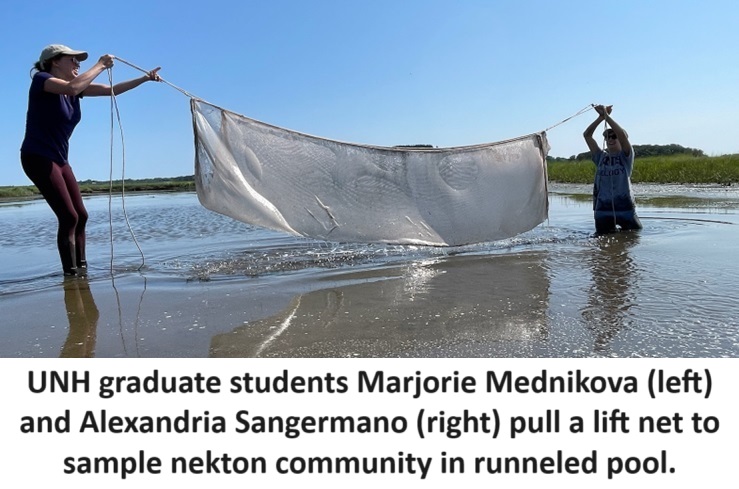 To explore the impacts of runneling on salt marsh nekton, UNH graduate student Alexandria Sangermano is monitoring nekton communities before and after the installation of runnels in the Great Marsh Estuary (MA-NH). Sangermano thesis project coupled traditional nekton sampling methods with the growing field of marine bioacoustics, a first for monitoring salt marsh restoration in New England. During the summers of 2022 and 2023, Sangermano and her team identified over 9,000 individual fish and crustaceans and recorded over 10,000 hours of ambient underwater sound throughout the Great Marsh Estuary. Currently in the throes of data analysis, Sangermano, with the help of UNH undergraduate Kailey Little (MEFB ‘26 ) uncovered a previously undocumented behavior by the salt marsh grass shrimp (Palaemonetes spp.).
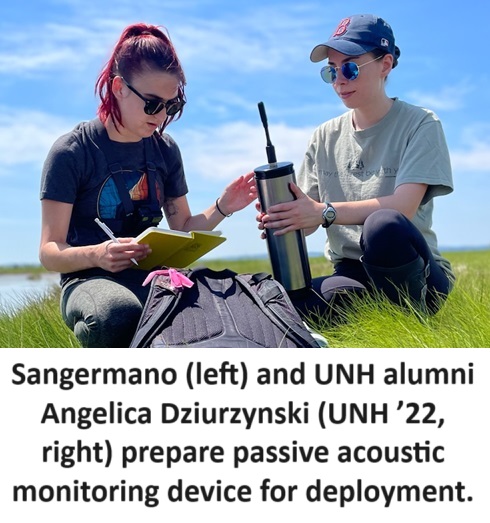 The acoustic data suggests that these tiny shrimp are producing impressive amounts of sound, referred to as “snap-crackle-pop’s” by Sangermano, a behavior which appears to only occur during daylight hours. This behavior could be used as a non-invasive way to monitor the abundance of grass shrimp, which have been touted as indicators of ecosystem health in salt marshes. A clip of this “snap-crackle-pop” sound can be accessed here. The use of vertebrate animals is this study received prior approval from the UNH Institutional Animal Care and Use Committee (IACUC, application #220302).