
Social Stratification in France And Its Relation To Food
By: Aubrey Johnson, Tyler Silverwood, Brandon Smith
Introduction:
Throughout the history of France, barriers between social classes have either been strongly reinforced or have been redefined in many ways. While there are many factors for the change or augmentation in social class, the one thing that has remained constant is food’s relation to social class. Since the French are passionate with how their food defines them as a country, it would only make sense that the French would care how food defines social class. The goals of this project are to view the number of ways of how food has defined social class throughout France. We will observe many periods of time including hunting and clergy prior to Louis XIV, the time of Louis XIV, the French Revolution, and globalization in the 1900s and 2000s.
Hunting and Access to Meat:
Post-serfdom, in the age of tenant farming peasants could farm their own land but often had to give 50% or more of the crop to the lord of the manor. This was a slight step up from the practical slavery of the peasant farmers. Now, peasants were able to keep part of what they produced for themselves, and thus many were able to live solely off of the land which they rented. “The food of the servants consisted especially of bread, butter, and cakes. Sometimes they received also bacon; other meat they got but rarely” (Sée 2004, pg. 20). Peasants at this time were also subjected to extraneous taxes on supposedly luxury goods such as salt, as well as to the church. According to an online history source, “that is why they always had to take their eggs, young cocks, butter and cheese, and the best of the fruit and vegetables to market” (Olver, 2000). Essentially, the peasants had little to no availability of meat and dairy for themselves because they were in such massive debt to the nobles.
It is important to note that the new manorial system also granted certain rights, including hunting privileges, to nobles exclusively. This means that in addition to what they purchased from peasant farmers, nobles were able to go out and collect their own fresh meat through the sport of the hunt. These practices often made life even harder for farmers.“The hunting right seems to have been the most odious of all the manorial monopolies, for the hounds of the nobles and the game of the vivaries ravaged the cultivated fields. This was a source of universal complaint in France” (See 2004, 21). A lot of resentment developed from the fact that peasants lost such a large portion of their crop not only through taxes, but also because of the luxurious hunting practices which destroyed their farmland. While they lived off of vegetable soups and bread, those of higher status took advantage of them and enjoyed the rewards of meat, eggs, and cheese.
Hunting as a Marker of Status:
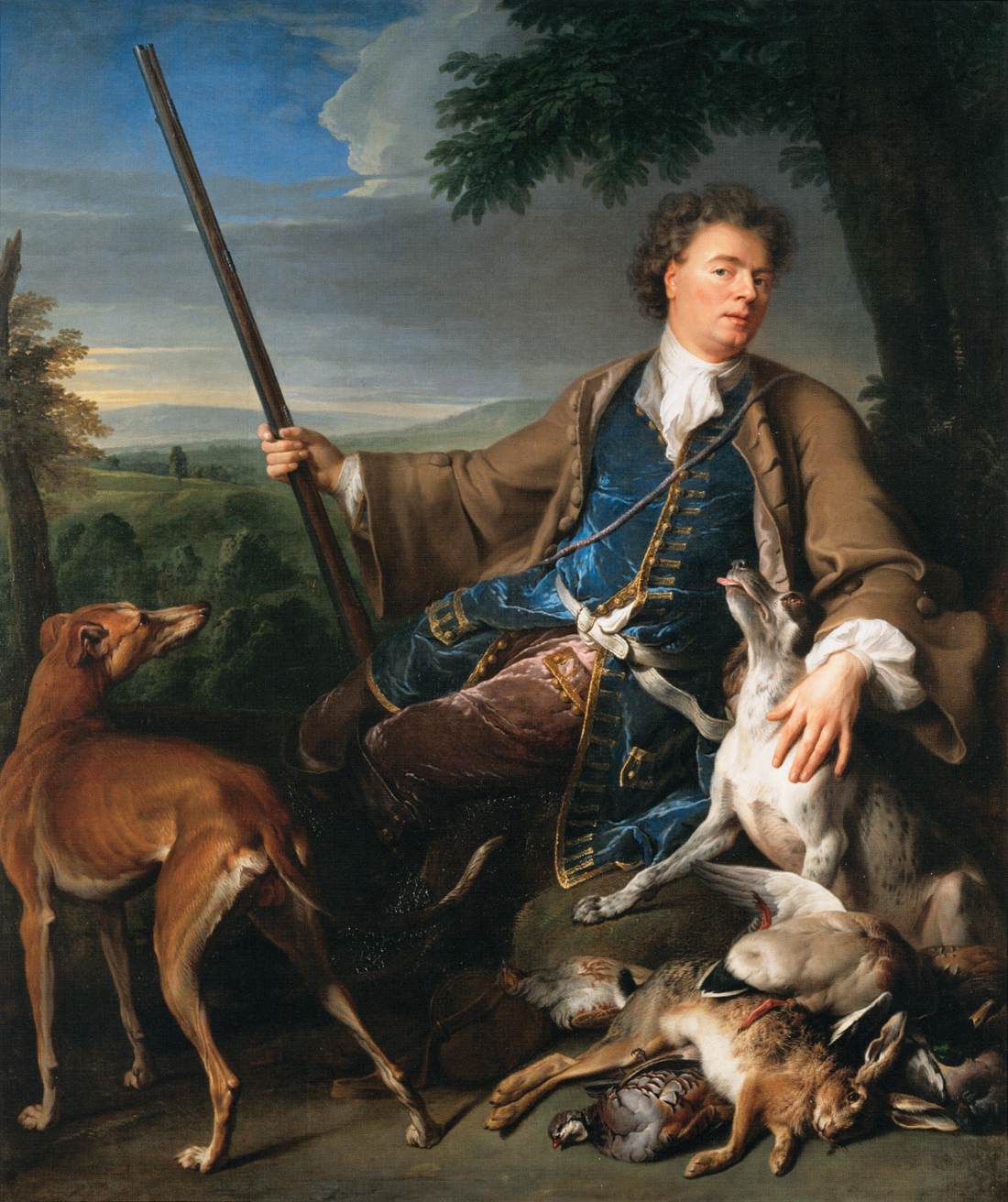
Because the ability to hunt was so restricted, it became a widely known indication of high status. For example, a mark of the highest elite at a dinner party would be one’s ability to distinguish wild game. In the “Champagne or Bordeaux” reading, the author analyzes Nicolas Boileau’s third satire, the burlesque Repas ridicule (1665). In the book, Boileau criticizes this idea of a superior taste by having his perfectly disgraceful protagonist praise caged rabbit and pigeon as their wild counterparts. The text states: “As for his low class, among the several indications the text provides is the fact that he mistakes domesticated game for (superior) wild game. This fits the logic of the text, since the right to hunt (le droit de chasse) was traditionally a privilege reserved only for nobles,” (Parker 2015, pg. 13). This was ironic because the protagonist was impersonating a high class individual to go to the dinner, but the fact that the game was not fresh means that the meal was inherently low status.
Furthermore, nobles utilized their hunting privileges to show off their high status. Though the nobles may have laid claim to multiple residences, the most well off would spend most of their time in the country. They would flaunt their freedom from working the land by taking lengthy vacations. Exercising the right to hunt was one of the most distinguished vacation activities, so those who could afford to do so would show it off.
 Globalization in Early France:
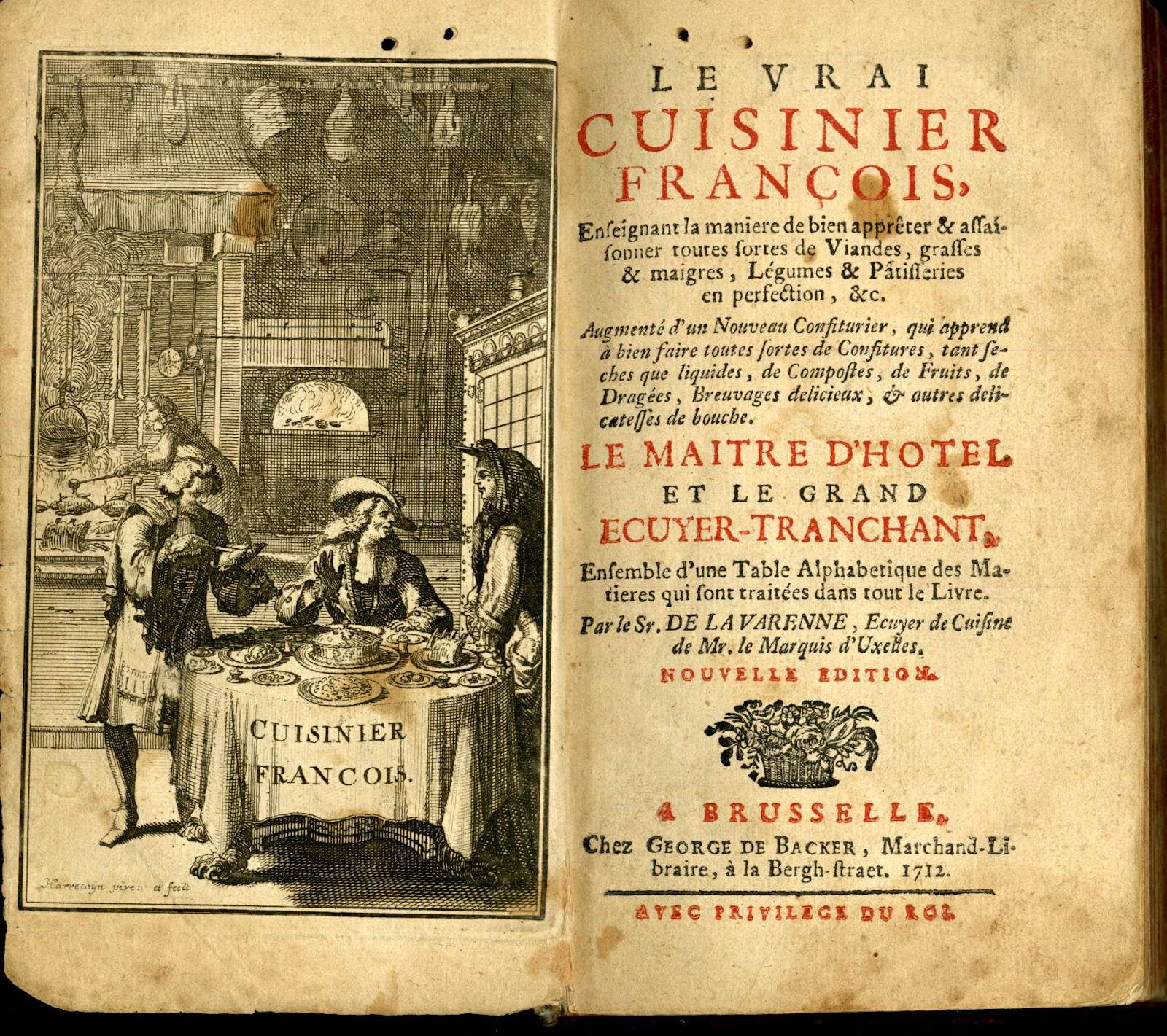
Following the invention of the printing press, French Chefs began spreading their ideas of the perfect cuisine, and that the ability to create French cuisine was what it meant to be a civilized country (Ferguson, 2014, p. 6). In 1651, the French chef François Pierre de la Varenne created the cookbook “Le Cuisinier François”, or “The French Chef”. This spread authentic French cuisine all across Europe, allowing for those who could afford cookbooks to be able to cook just like the French. High class tastes became even more widely associated with top tier French food.
The Time of Louis XIV (1643-1715):
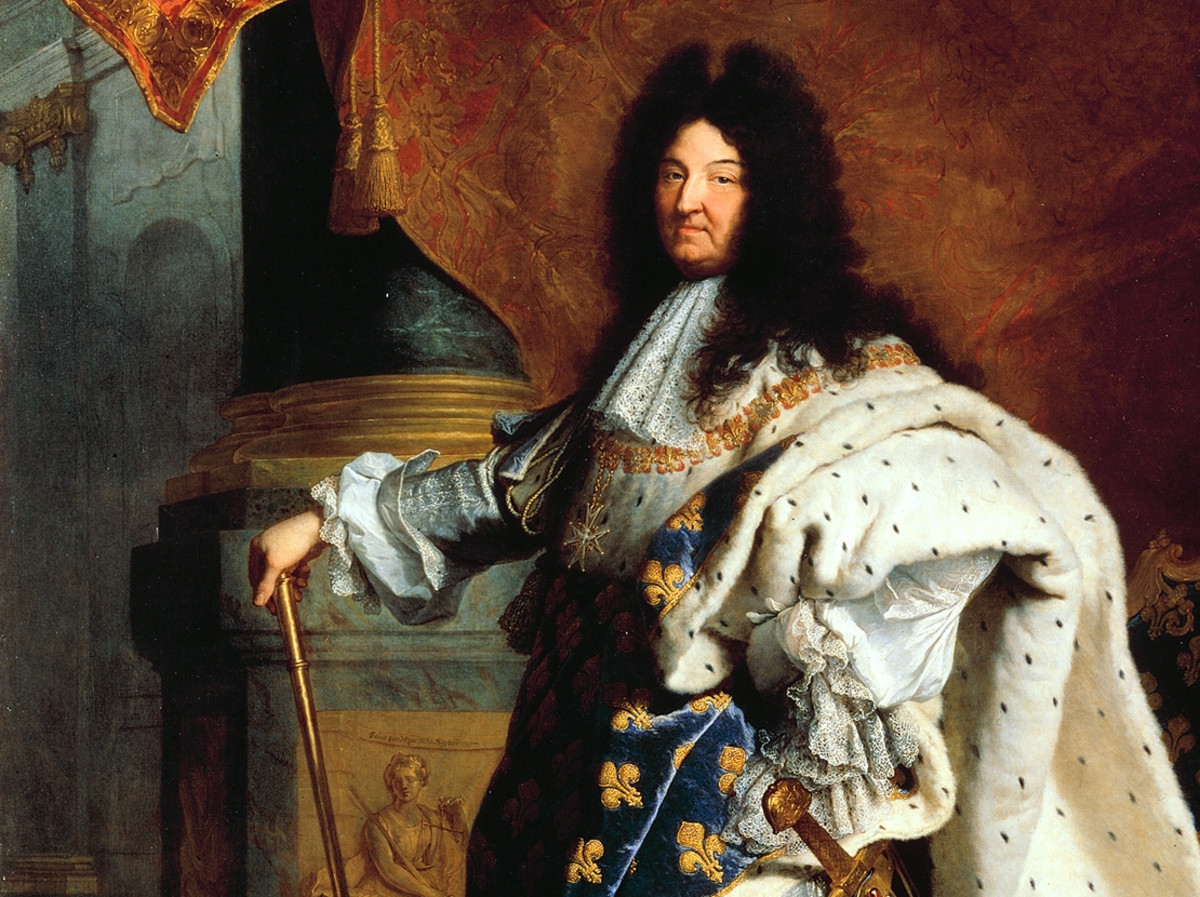
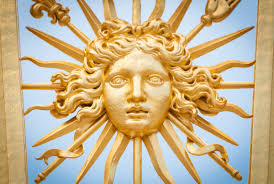
The Sun King in all of his magnificence.
Below is a link to a scene from the film Le Roi Danse. Notice how Louis XIV is the center of attention during the dance while making himself to be a spectacle to behold.
https://www.youtube.com/watch?v=PdeqbpfXaK8
Louis XIV’s Vegetable Garden and the Idea of Terroir
The rise of Louis XIV saw the demise of terroir from the vocabulary of the upper classes while being preserved by the lower classes. Terroir is the idea that certain soils are best suited to produce certain crops based on the climate they receive. Prior to Louis XIV, terroir was the dominant view in society with farmers understanding that people need to live with  nature. The best representation of this idea was from a book written in 1600 by Olivier de Serres known as Le théâtre d’agriculture. In the book, a character known as pere de famille would constantly talk about how certain soils were better than others at producing certain crops based on soil while also stressing the idea of understanding nature. Here is what the book looked like.
However, once Louis XIV came into power, the book’s influence quickly dissipated. Louis XIV’s ego did not allow him to live with nature; he wanted to dominate nature. Louis XIV did many things to dominate nature such as growing his vegetable garden over a sinkhole, growing the garden in a very symmetrical fashion, and making passageways over the vegetable garden to make it appear as though a person is above nature. Not only did Louis XIV seek to dominate nature in terms of what crops to grow, he dominated how the dinner table should be organized as well.
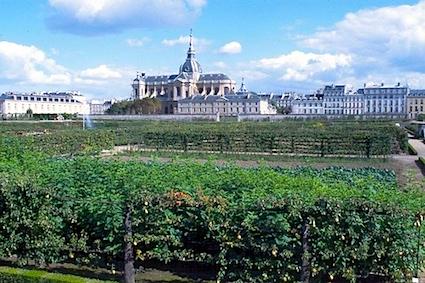
Louis XIV’s Vegetable Garden as seen today.
Below is an article to look at even more pictures and information on Louis XIV’s vegetable garden.
http://cityfarmer.info/kitchen-garden-of-king-louis-xiv/
Louis XIV and Etiquette
The dinner table became more of an extravagant affair for the upper class after Louis XIV redesigned what a meal should look like. First, Louis XIV introduced different types of food that should be consumed while getting rid of others. With his vegetable garden, Louis XIV introduced a great variety of vegetables to the meal of the upper class such as salads, asparagus, peas, and artichokes. Spices, once used in a variety of dishes as they were the epitome of status, were used minimally while more emphasis was placed on the food. Fatty and creamy sauces were used in replacement of mustard while sugar was now only used in desserts in order to focus on the flavor of the food more than spices. Second, Louis XIV introduced table etiquette for the upper class to follow. This included implementing the butler and the napkin, a table setting with appropriately placed silverware to give a symmetrical appearance, and having food brought out all at once. Louis XIV getting rid of terroir and introducing etiquette heavily influenced the upper class of this time to write cookbooks that targeted the bourgeoise while segregating the lower classes.
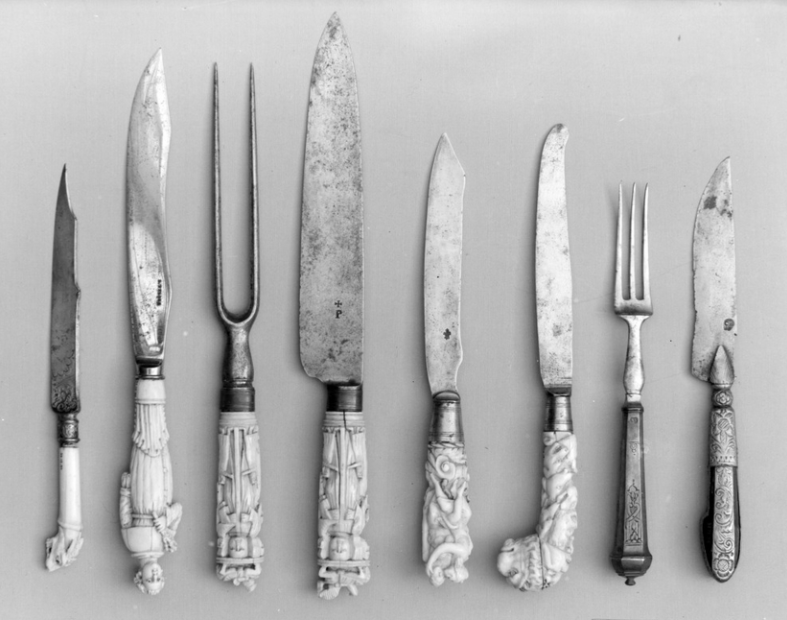
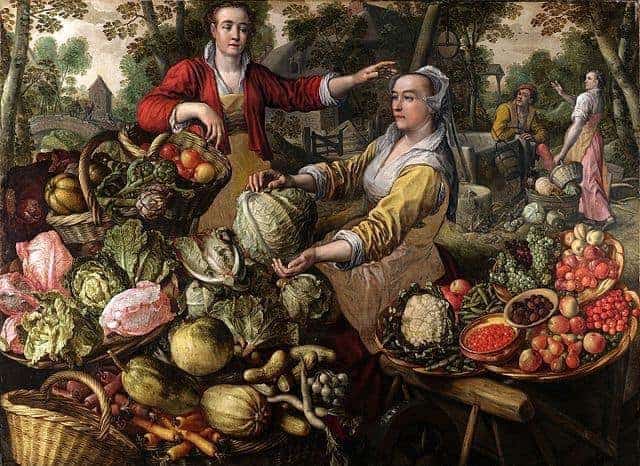
Notice how all of the silver is symmetrically placed and all the vegetables and fruits being placed in baskets. This marks a good sign of high class.
Below is a link at a modern take of the meal of Louis XIV at a hotel in France.
https://www.youtube.com/watch?v=w_L_3FHN03w
Cookbooks Inspired by Louis XIV and Peasant Cuisine
The mark Louis XIV left on the upper class would soon be spread to the bourgeoisie. During Louis XIV’s reign, a number of cookbooks were written that embodied the ideas of Louis XIV such as dominating nature, focusing on the aesthetics of the food rather than the health of the food, and enforcing the ideas of etiquette. These cookbooks were written for the bourgeoisie as the bourgeoisie could afford the books and were deemed worthy enough to live with the ideals of the sun king. This allowed the bourgeoise to seemingly rise up the social ladder to be like the upper class by teaching them focus on food taste more than cooking skills.
However, Louis XIV’s influence did not reach the peasants of France as they were not seen as worthy of practicing Louis XIV’s ideas, and they were not rich enough to buy a cookbook inspired by him. The peasants had their own cuisine known as peasant cuisine, which emphasized production while minimizing costs. In fact, peasants still relied on the idea of terroir as they could only afford local crops and seasonal variations such as drinking wine based on its terroir. Eating and drinking based on terroir was seen as low class, making the peasants even more segregated from the upper class during the time period. Louis XIV revinevented cuisine for the upper classes while strengthening barriers between the upper class and the lower class based on the type and preparation of food.
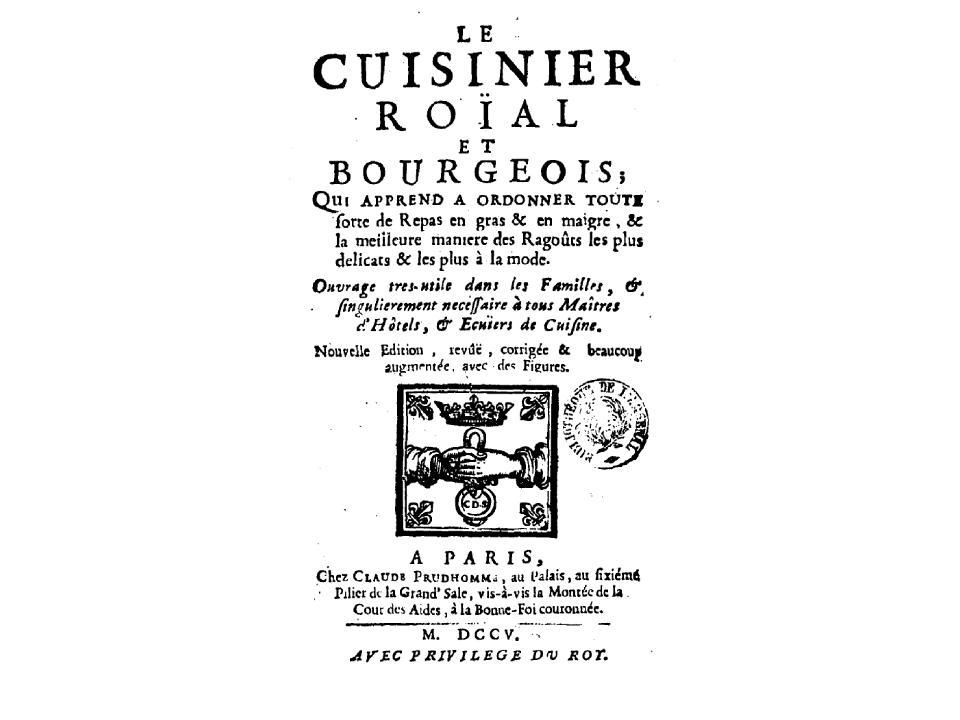
A cookbook for the bourgeoise specifically.
Origin of Food:
Following the introduction of vegetables and fruits to King Louis the XIV’s dining table, their relevance across all social classes increased. This shift in cuisine also included placing a focus on local fresh ingredients such as vegetables, milk, cheeses, and breads. Nicolas de Bonnefons’ “Les délices de la compagne” advocated for home cooking, and the the use of these local/home garden products (Colas et al., 2018, p. 165). Also during this time, simplicity and delicacy was focused, and the use of rich, overpowering sauces and spices shifted to the use of sauces that instead complimented the natural flavors of the ingredients. The purity of taste of these ingredients was also stressed, and the ideals that developed during this time eventually lead to those in the Michelin Guide.
Closer to the 19th century, there was a shift from service a la Francaise, service of multiple dishes for each course, to service a la Russe, service of dishes sequentially. This introduced more variety into the meals of the French, and was believed to be introduced by a Russian ambassador to Paris. Such a change is indicative of the overall trend of the French cuisine to favor intricacies and delicacies (Colas et al. 2018, p. 164).
Louis XIV and Globalism:
 French Globalism at this point in time can be boiled down into one food -- sauces. For years, French chefs had been spreading their cooking ideas all across Europe: and Europe was having an effect on them. They took native foodstuffs from other countries, and in a move that could be described as uniquely American, adapted them to their own tastes. Such a practice could be called ‘frenchifying the exotic’ (Ferguson, 2014, p. 8). At the coronation ceremony of King Louis the XIV’s son as the King of Spain, he was presented with the ‘sauce espagnole’, a traditional brown sauce. And, within a few years, it was so Frenchified (some would say ‘perfected’) that the original sauce would be unrecognizable. The same occurred with the ‘sauce allemande’, a white sauce, that was Frenchified from Germany (Ferguson, 2014, p. 7).
The Clergy:
At this point in history, church officials were distinctly divided into high and low clergy groups. While the low clergy led lives more resemblant of peasants, the high clergy are comparable to the noble status. Those members of religion who were actually serious about the service of God lived, like the peasants, off of their own land. Meanwhile, upper clergy often came already from a high class background and were hand picked for their positions by the king. “The lower clergy came almost entirely from the third estate; humble, poorly paid, and generally hardworking, the priests resented the wealth and arrogance of their ecclesiastical superiors,” (Anderson 2008). High clergy members were more interested in finances than religion, and took advantage of the church to feed their own wealth. They set exorbitant taxes and convinced churchgoers that paying them would guarantee a spot in heaven. In the end however, the majority of those taxes were directly pocketed rather than being fed into the church.
Culinary Trends of the Clergy:
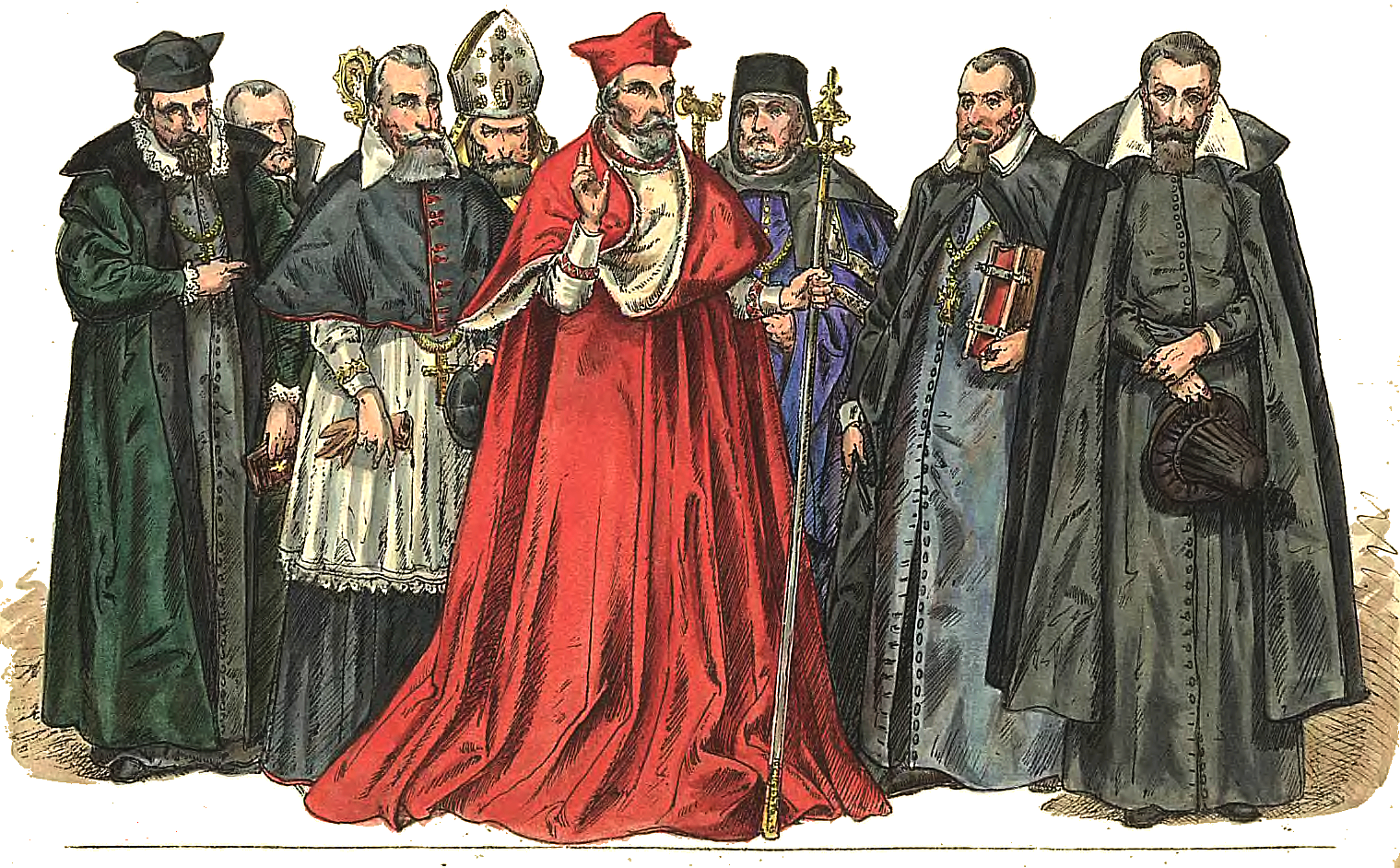 The lower clergy came from commoners (the third estate) and lived hard working lives. They ate many of the peasant dishes and also worked a lot of their own land (again, a trademark of the lower class). As one text explained, churches more focused on charity work were often underfunded; “Their material condition, too, was less prosperous. They possessed little real property and derived income only from personal property,” (Sée 2004, 42). Upper clergy came from rich noble backgrounds, and they ate like it. They took part in extravagant meals and ate plenty of meats and cheeses. These feasts were a further separation between the two levels of membership. The lower clergy was outwardly frustrated by the frivolity of their superiors, but had little say in the matter.
Precedence of Wine over Bread Prior to the French Revolution:
During the 1700s, wine was a rising industry marked by prosperity for the bourgeoisie, especially in the Bordeaux region. While the government was heavily investing into land and for transportation for wine, a crisis of unemployment and rising bread prices was plaguing the lower class. This was an issue for the lower class as “subsistence at any level among peasantry...was largely dependent on bread” (Brace, 1946, p. 650). The issue was never addressed by the French government as bad transportation between 1725-1789 resulted in 33 bad harvests. In addition, bread prices rose so high by 1789 that they became 88% of a peasant’s budget. The upper class took advantage of this by hoarding the bread as they were able to afford it, causing grave malnutrition for peasants. The peasants had enough and became united under the banner of better treatment based on the indifference the government showed to their main food item. This led to the Women’s Bread March to Versailles in 1789, citizen armies forming in many towns, and many peasant revolts that sparked the French Revolution.

Chart of the dramatic rise of bread prices.
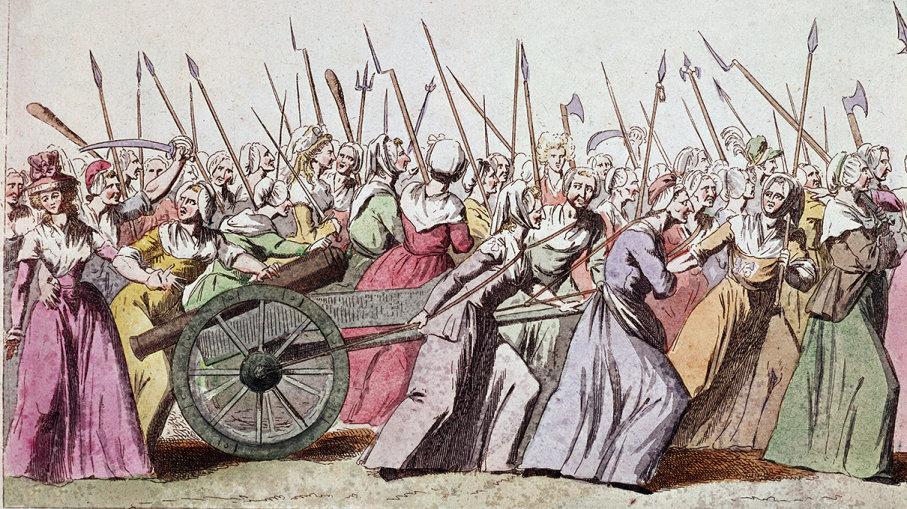
A depiction of the Women’s Bread March.
 Violence of The French Revolution:
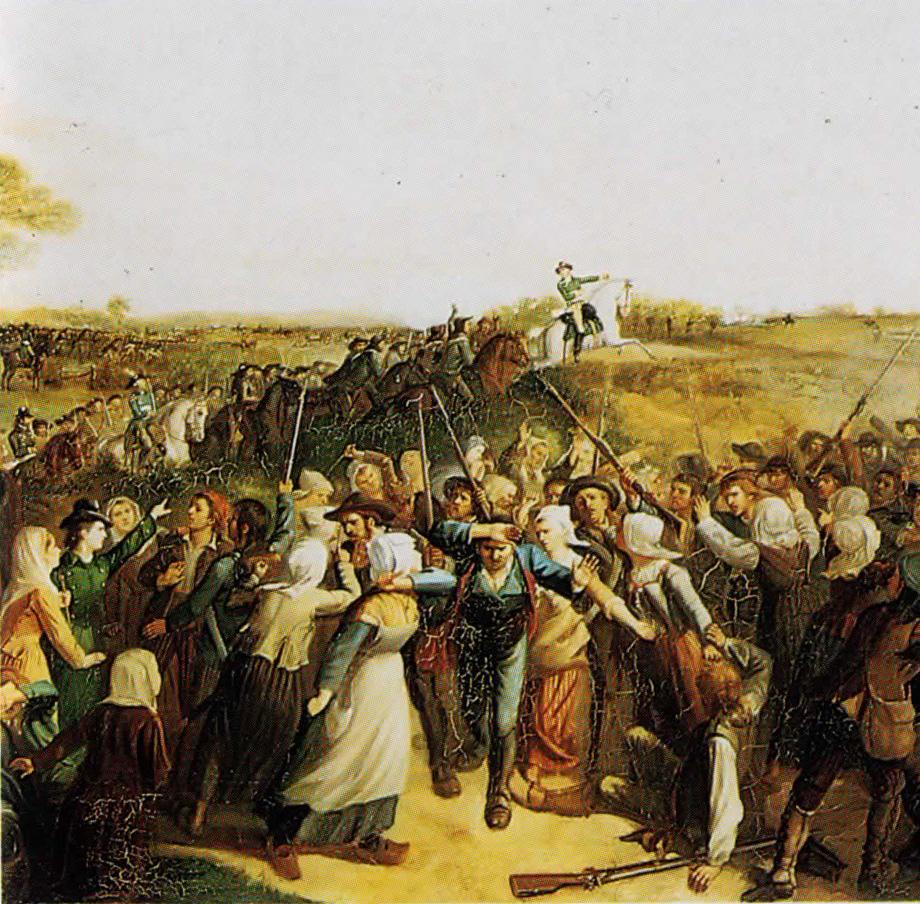
Anger over unfair bread prices swept across France very quickly, affecting the upper class in ways they have not felt before while uniting the lower class. Between 1792-1793, peasant revolts broke out throughout France leading to bakeries being wrecked, noblemen being attacked, and peasants calling out the upper class for taking advantage of them. Rather than pacify the situation, King Louis XVI called for the execution of peasants in August of 1792, which enraged the peasants enough to march to Paris and demand his execution in December of 1792. Louis XVI would later be put on the guillotine in January, but the anger of the peasants did not subside. They criticized the upper class for dehumanizing the lower classes by not caring about their bread situation, the bourgeoise for taking advantage of a booming economy rather than help them, and for hoarders consuming their main food staple. Clearly bread was the one thing that unified the peasants together to fight against the special treatment the upper class received, and it made them passionate enough to commit a number of revolts and calls for executions.
A Peasant Revolt in 1793.
Below is a link to a video from the movie Les Miserables depicting peasants speaking out against their terrible way of life.
https://www.youtube.com/watch?v=88Y7in-04Ng

Globalization of French Revolution:
French Chefs travel to other countries, especially England, to share their culinary talent and the French cuisine. In a sense, they are invading these countries with their delicious foods, reminding everyone that, without French cuisine, they would just be lowly plebeians (Ferguson, 2014, p. 11). French Chefs, as mentioned before, do adopt some cuisine from other countries. But an important distinction between France and other countries, especially Eastern ones, is that the French focus purely on the taste of the food. Many eastern countries tie philosophical and medicinal discussions into that of food, such as considering the balancing of the humors (Ferguson, 2014, p. 12). But the French ate food for food’s own sake. The taste of the food was of utmost importance, and little time was spent dabbling in philosophy. A comparable, but not identical, stance can be seen in America: for the middle and lower classes, food exists chiefly for the consumption of calories, for utility.
An interesting comparison is that of America’s Thanksgiving Dinner to France’s Gastronomic Meal. It shares many similarities -- it is a meal that brings a family together, and is typically prepared by the entire family. It also inspires patriotism, just like the French gastronomic meal.
WWI and WWII:
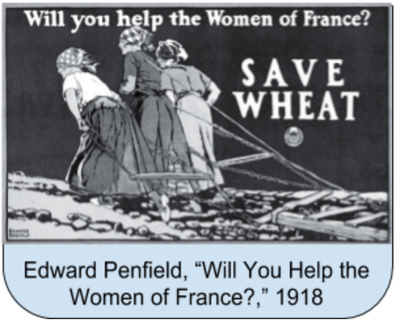
France outlawed the Baguette in 1917 due to flour shortages from the destruction of wheat fields (Viet, 2013, p. 62). Only half of demand was produced, and the government forced pastry shops to close for two days/week. The middle class was affected the most: consumers relied on these shops for their food, while producers lost a solid amount of income. The rich could just make their own flour-based foods, while the poor didn’t rely on breadstuffs as much, instead opting for soups. In typical French fashion, food riots revolved around low-quality food, not lack of food. During the aftermath of the World Wars, the US Food Administration was responsible for sending food to European Allies (Viet, 2013, p. 63). France became the primary recipient, because its farmland was decimated by the German occupation. This lead some American pundits to claim that agriculture had become just as important as natural resources in geopolitics, and that the United States “need be afraid of no nation [because an exhausted Europe] would eat out of [our] hands” (Viet, 2013, p. 61). For a long period following the war, US foodstuffs were responsible for keeping France afloat. American visitors to France were treated like royalty, with everyone (from the richest rich to the poorest poor) making them the best possible food France had to offer, even if they didn’t have enough for themselves.
The Modern Era:
Perhaps the most jarring effect that the modern era has had on France has been its membership in the European Union. While the French are no strangers to a centralized government, the French government would (in theory) always put the interest of its constituents first. Now, as a member of the EU, the French citizens must face the consequences of governmental decisions that will not always be in their best interest. On the topic of food, this is primarily evident in the marketing of lower-quality foodstuffs in France. The European Union high court rules that all member states must accept the marketing of foods made by other member states, unless they can prove that the product raises safety issues -- this is known as the Precautionary Principle (Coutrelis and Weber, 2009, p. 84). Specifically of note is chocolate, which France required to be made of 100% cocoa butter. But, following a EU court ruling, products marketed as chocolate by any member state no longer needs to contain 100% cocoa, and can have fillers such as wheat.

In yet another strike to something that is considered widely French, in 2008, the Consil D’etat (French high court) struck down a ruling by a lower court that animal meat could be marketed with terroir, that it found that the relationship between the origin of the animal and the quality of the meat had not been proven (Coutrelis and Weber, 2009, p. 83). While the optics of terroir have flip-flopped throughout time, once being considered a product of the lower class, and then one of the upper class, such a ruling seems to suggest that terroir has become a thing of the past.
Not only are the laws changing, but so is the culture surrounding food. As evident throughout the world, young people are trending towards sources of food that are more convenient for them. Many young French people are throwing away the importance of quality, and lack of snacking, that has persisted throughout France’s history, instead opting for a quick, pleasureful meal (Pettinger et al., 2004, p. 314). A restructuring of meal timing, and the rise in the importance of time in the mimicry of America, has also diminished the availability of a high-quality, sit-down family meal. In America, we have brown bag lunches -- perhaps in France, they will soon have the same.

Conclusion:
Our research has revealed that food has been a key catalyst in determining social stratification throughout France’s history. In the early ages, the rights of the upper class to hunt defined their wealth in the ability to serve fresh meats. This, along with the concept of terroir, led us to the realization that one’s palate and personal tastes were what differentiated their social status even more than financial wealth. Finally, we discovered that globalization in the modern era has allowed for a variety of quick, cheap, and easy access foods for everyone, causing less of a divide between the lower and upper classes.
Works Cited:
Anderson, Marge. “The Clergy and the Nobility | the French Revolution.” Big Site of History – History of Civilization, 9 June 2008, bigsiteofhistory.com/the-clergy-and-the-nobility-the-french-revolution/.
Brace, Richard Munthe. “The Problem of Bread and the French Revolution at Bordeaux.” The American Historical Review, vol. 51, no. 4, 1946, pp. 649–667. JSTOR, JSTOR, www.jstor.org/stable/1843902.
Clark, Priscilla P. “Thoughts for Food, I: French Cuisine and French Culture.” The French Review, vol. 49, no. 1, 1975, pp. 32–41. JSTOR, JSTOR, www.jstor.org/stable/389684.
Colás, Alejandro, et al. “Distinction: Social Difference, Taste, and the Civilizing Process.” Food,
Politics, and Society: Social Theory and the Modern Food System, 1st ed., University of
California Press, Oakland, California, 2018, pp. 150–168. JSTOR,
www.jstor.org/stable/10.1525/j.ctv5j026t.12.
Coutrelis, Nicole, and Isabelle Weber. “France.” European Food and Feed Law Review, vol. 4,
no. 1, 2009, pp. 82–85. JSTOR, JSTOR, www.jstor.org/stable/24325123.
Ferguson, Priscilla Parkhurst. “Thinking About Food.” Word of Mouth: What We
Talk About When We Talk About Food, 1st ed., University of California Press, 2014, pp.
3–32. JSTOR, www.jstor.org/stable/10.1525/j.ctt7zw4qn.4.
“History of Gastronomy: The Birth of the Haute Cuisine.” Gastronomos, 16 June 2018, gastronomos.fr/en/culture/history/history-of- gastronomy-the-birth-of-the-haute-cuisine/.
Jaurès, Jean, et al. “The Enragés against the High Cost of Living.” A Socialist History of the French Revolution, Pluto Press, London, 2015, pp. 140–168. JSTOR, www.jstor.org/stabl e/j.ctt183p2pt.15.
Olver, Lynne. “Colonial America & 17th/18th Century France.” The Food Timeline: History Notes--Restaurants, Chefs & Foodservice, 2000 www.foodtimeline.org/foodcolonial.html#louis
Parker, Thomas. “FIVE- Saint-Évremond and the Invention of Geographical Connoisseurship.” Tasting French Terroir: The History of an Idea, JSTOR, 2015
Parker, Thomas. “France’s Green Evolution: Terroir’s Expulsion From Versailles..” Tasting French Terroir: The History of an Idea, 1st ed., University of California Press, 2015, pp. 73–92. JSTOR, www.jstor.org/stable/10.1525/j.ctt14btfqt.9.
Pettinger et al. “Psycho-social influences on food choice in Southern France and Central
England.” Appetite, vol. 42, no. 3, 2004, pp. 307-316.
https://doi.org/10.1016/j.appet.2004.01.004.
Sée, Henri. Economic and Social Conditions in France During the Eighteenth Century. Batoche Books, 2004
Veit, Helen Zoe. “FOOD WILL WIN THE WORLD: Food Aid and American Power.” Modern
Food, Moral Food: Self-Control, Science, and the Rise of Modern American Eating in the
Early Twentieth Century, University of North Carolina Press, Chapel Hill, 2013, pp. 58–76. JSTOR, www.jstor.org/stable/10.5149/9781469607719_veit.7.