
Group 6
French vs American Grocery Habits
If you want to live, there is no avoiding food. One of the few universal rules dictates that all humans must eat to survive. Americans and the French alike have their own views of what food represents, but one thing we have in common is how we get our food in the first place. French and American supermarkets, despite looking similar, hold many different types of items. With more specialized areas (bakeries, cheeses, wines, and meats) and a much larger organic (Bio) section, French supermarkets have proven to be the superior option. Yet that is not without their magnetic attraction to the American way of shopping.

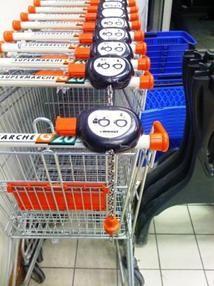
The French grocery store experience starts with the customer choosing a cart in the front of the store. Many of the large grocery stores have people rent their cart by inserting one euro in a coin slot. Once the customer returns it to the front of the store and relocks them, the coin is given back. In crowded cities where you can’t drive around easily many people bring their own carts to help carry their grocery bags back home (Paris Perfect).
Once they have their cart the first stop is to the produce section of the store. The fruit and vegetable section are can be smaller depending on the size of the store because many people buy their produce from the local farmers market (Follow Me Away). Near the oranges most stores also have a machine where customers can freshly squeeze their own orange juice and they can pick from a variety of bottle sizes (Paris Perfect). Along with the fruit and vegetables in the produce section they carry a selection of canned and frozen options (Follow Me Away).
Next you would find the bakery with a large selection of different breads and pastries. All of the bread is freshly baked and served that day. The baked goods such as cakes and croissants come both freshly baked and prepackaged. The deli section of the store has an array of sliced and precut meats. The sliced meat is either smoked or roasted and freshly cut for you. The other meats can either be prepackaged or they have a small selection of freshly cut meat from that day. Specialty meats for dinner parties or other special occasions are usually bough from a local butcher shop rather than the grocery store (Paris Perfect).
The dairy section is one of the largest sections in a French grocery store. They have a wide selection of cheeses and yogurts however, like the deli section, important cheeses for special occasions or dinner parties are bought from neighborhood fromagerie. The milk unlike the other dairy products is rarely refrigerated and is packaged in smaller bottles. French grocery stores of the years have increased their frozen section and is becoming more American. They offer a variety of dinner meals, fruits and vegetables, and different frozen desserts (Paris Perfect).
The checkout process is fairly similar to most grocery store in America however the cahiers will not make small talk or smile at you unless you are a regular or a close friend. It is also polite to have your money ready before they are done ringing up all your items (Paris Perfect). Some stores also make you pay for your grocery bags so many people bring reusable grocery bags. The hours for many French grocery stores are from eight-thirty in the morning till nine o’clock at night. The busiest time to shop is from five to seven pm because many people come to buy their food to make dinner (Follow Me Away).
Organics and GMOs in Food Production
European Union council regulation on organic food production (used in France): “Organic production is an overall system of farm management and food production that combines best environmental practices, a high level of biodiversity, the preservation of natural resources, the application of high animal welfare standards and a production method in line with the preference of certain consumers for products produced using natural substances and processes.”
The organics section in French supermarkets (called la section Bio), is enormous. Most produce bought from these markets are organic, and Chuck Dinerstein of ACSH news crafted a study to link the health habits of French people who eat organic and their exercise habits. These people are much less likely to smoke and make up a large majority of the affluent and highly-educated groups of people. This is a pattern that can be seen in the US as well, but on a much smaller scale. Over 40% of French adults say that they make an effort to include organic products in their shopping lists, from produce to meats to dairy, according to a recent survey from l’Agence nationale de sécurité sanitaire de l’alimentation, de l’environnement et du travail (The National Agency for Food Safety, Environment, and Work).

 In France the labeling for organic foods is much stricter than the US. It requires no use of synthetic pesticides of processes, unlike the US where the organic label can be placed on a product with very little regulation and still can contain traces of pesticides and synthetic processes (Dinerstein 2018).'
The market for organic foods in France is also much larger than the US, being worth an estimated €7 billion (roughly $8b) in 2016 , compared to the meager US organic sector worth $3 billion in 2016. It is also important to note that the population of the US in 2016 was and still is significantly larger than the population of France, being 327 million people compared to 67 million people. The French market then grew 17% in 2017, compared to the US's growth rate of 6.4%.
In the U.S. each state is responsible for food retail, preparation, and handling codes. These health codes are laws that supermarkets and food retailers like restaurants have to abide by to reduce the risk of foodborne illnesses and ensure food produce and products are free of harmful bacteria, and won't get the consumer sick. With food retail, food is not allowed to stay out in supermarket shelves and freezers past its expiration date. There are also certain ways that food products need to be stored, like how milk and most dairy products are put in refrigerators. With food preparation and handling, all food preparation stations in supermarkets have to be cleaned and disinfected in between working with different foods, and the workers have to wear certain protective garments like plastic gloves, hairnets, and the proper clothing to keep the public safe and themselves safe.
GMOs are to only be grown, sold, or used “in a manner that respects the environment and public health, agricultural structures, local ecosystems, production and commercial channels labeled as ‘without genetically modified organisms,’ and with full transparency.” the french have the freedom to consume and produce food items with or without genetically modified organisms.” French legislation aims to limit the spread of GMOs to areas outside of their intended fields. the cultivation, harvest, storage, and transportation of genetically modified crops are subject to certain technical rules. These rules are established by the minister of agriculture, after consultation with the Haut Conseil des biotechnologies and the minister of environment. Article L663-2 specifies rules for distances needed between genetically modified crop fields and other fields as crucial in avoiding the accidental presence or exposure of GMOs to non GMO crops. Violations of these rules on separation distances can be punished by the penalty for non-compliance, which is a fine of €75,000 and two years of incarceration. Important note: the distances have yet to be defined as of this moment.
GMOs in the U.S. however are legal to sell in supermarkets but as of right now they are not required to be labeled. Although by 2020 all food manufacturers in the U.S. will be required to label their products saying either they contain no GMOs or that they contain a percentage of GMOs, and what that percentage is. The proposed guidelines for food labeling are that the packaging say bioengineered or BE. “Food makers would be given a choice of three disclosure methods: spelling out the information, as in “contains a bioengineered food ingredient”; using a standard icon (the agency proposed several evoking sun and smiles); or affixing a QR code that directs consumers to a website with more information”. Also there are no laws on mandatory distances GMO crops have to be from non-GMO crops to prevent cross contamination.
Food Shopping Culture and its Changes
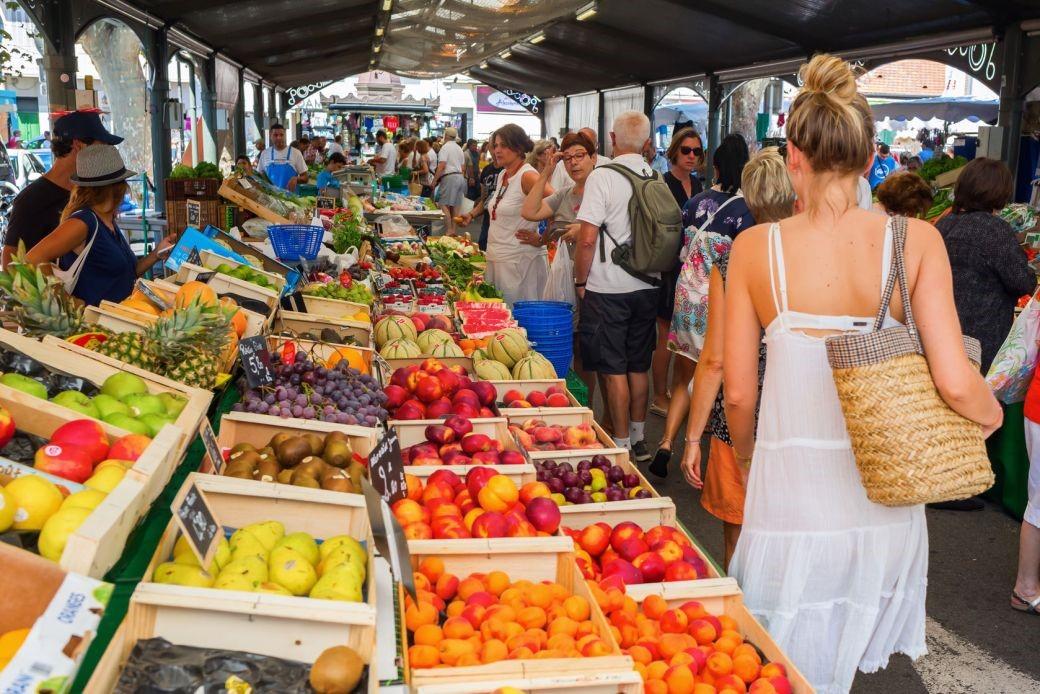
Traditionally, French grocery shopping happens daily. Visits to the butchers, bakers, produce markets, and other small local shops make up a classic French citizen's day. More recently however, these habits are changing. Four years ago it was common to find sacks of unwashed potatoes at the store. Now it is normal to find pre washed and frozen, precooked potatoes, the faster, easier version of cooking. In the past, French consumers had limited fresh/frozen food storage at home, but recent sales figures have pointed to a record sales of both freezers (over 1.9 million units sold), and microwaves (over 1.5 million units sold). Now, supermarkets are the dominant retailer of food. It is estimated that french shoppers make over 50% of their food purchases in supermarkets rather than smaller food stores. Wholesale chain stores such as Costco offer large quantities of food items such as snacks, pantry items (spices, flour, etc.), canned and frozen foods, and other food items that do not go bad as quickly. While this bulk buying method may be unheard of to a traditional French citizen, where cooking with fresh foods is most important, it is extremely common in the United States. People do not want to go to the grocery store every night for dinner, so stocking up on food that is easy to make and store is just part of the culture.
Why the switch? Changes in household structures, like fewer marriages, have resulted in more single households, meaning that there is a larger need for single portions and prepared meals as shopping time is limited.
-
Work weeks in france are becoming shorter, meaning that there is less time for lunch to make room for an efficient day, which leads to an increased need of snacks
-
More traveling outside of France has lead to an interest in other ways of cooking and eating
Over two fifths of french women are now in the workforce and because they are traditionally the ones who do the cooking, they no longer have the time to cook. The need for foods that require less preparation time is now much greater than before, allowing read-to-eat meals and microwavable foods to take the forefront of French life. Because of the growth in store size, French consumers are now preferring to make weekly trips to the one-stop supermarket.
In comparison, the foodshopping culture in America is all about supermarkets. Grocery stores earn $650 billion annually, and $1 trillion if you count all retail food sales. About 50 years ago, people would shop in a similar fashion as the French, where they would attend as many as five grocery stores, filling up cart after cart with items specific to particular stores. Although this is similar to the traditional french shopping habits, people would fill their carts, stocking up on a week's worth of food rather than one day’s worth. In addition, because the U.S. is such a melting pot of cultures, many different types of cuisines are available at almost all supermarkets. It is possible to go into the store and buy Spanish, Indian, and Chinese foods all in one stop (Trigg). This is important to U.S. culture because of the many ethnicities that make up the country, and also because Americans enjoy many different types of food. Where in France, one would have to travel to a specialty store to pick up taco supplies, it would be strange in America to not have that option at the normal supermarket (Trigg). Of course, not all types of food are in every store and sometimes a trip to a specialty store is necessary, but in general if you wanted to sample a different cultures food, the supermarket is still the one stop shop.
Today, convenience has become the explicit command within food manufacturing companies since the 1950s- companies try to shorten cooking time as much as possible. Because of the new pressure on 'fast foods', Americans are more likely to choose:
-
Food that is cheap, quick, and will last longer than one day
-
Frozen dishes that are high in unhealthy fats
Because of this, America has created a large issue with obesity. In efforts to counteract this problem, people opt for fat free dishes, but usually fat free dishes substitute the fat for equally as bad substances, like high fructose corn syrup. American food is even made with more preservatives so that it can last a while and prevent extra runs to the grocery store, and is even stored differently (“Grocery Shopping in France”). For example, milk would never be stored outside of a freezer like it is in France.
Americans are not as knowledgeable about healthy foods as the French and will trust what labels say, while the french are more likely to shop in markets and at smaller food stores where false labels are less common.
Bibliography
Center for Food Safety and Applied Nutrition. “State Retail and Food Service Codes and Regulations by State.” State Retail and Food Service Codes and Regulations by State, FDA, www.fda.gov/food/guidanceregulation/retailfoodprotection/foodcode/ucm122....
“Changes in How French Eat and Shop Open Doors for U.S. Food Exporters.” AgExporter - United States Department of Agriculture,
Foreign Agricultural Service (USA), no. 11, 1989, p. 8. EBSCOhost, search.ebscohost.com/login.aspx?direct=true&db=edsagr&AN=ed
sagr.US9017543&site=eds-live.
“Code of Federal Regulations.” ECFR, www.ecfr.gov/cgi-bin/text-idx?SID=8d196b39a651ab70ca5424ba11e7acb3&mc= true&node=se7.3.205_1203&rg=div8.
Dinerstein, Chuck. “The French Chime in on Organic Food and Health.” American Council on Science and
Health, 1 Nov. 2018, www.acsh.org/news/2018/10/22/french-chime-organic-food-and-health-13530
“France to Make Half of All Food in Public Sector Organic or Local by 2022.” Organic Consumers Association, www.organicconsumers.org/news/france-make-half-all-food-public-sector-or....
Harmon, Amy. “G.M.O. Foods Will Soon Require Labels. What Will the Labels Say?” The New York Times, The New York Times, 12 May 2018,
www.nytimes.com/2018/05/12/us/gmo-food-labels-usda.html.
Follow Me Away. “5 Things To Know About Grocery Stores In Paris.” Follow Me Away, 18 Jan. 2019,
www.followmeaway.com/5-things-to-know-grocery -stores-in-paris/.
Journalist, Connexion. “Organic Food Sector Booming in France.” Organic Food Sector Booming in France,
17 Sept. 2017, www.connexionfrance.com/French-news/Organic-food-sector-booming-in-France.
“Lex Access to European Union Law.” EUR, eur-lex.europa.eu/legal-content/EN/ALL/?uri=CELEX:32007R0834.
Nicolas. “Restrictions on Genetically Modified Organisms: France.” Restrictions on Genetically Modified
organisms: France | Law Library of Congress, 1 Mar. 2014, www.loc.gov/law/help/restrictions-on-gmos/france.php.
“Organic Standards.” OTA, ota.com/advocacy/organic-standards.
Paris Prefect. “Tips to Help You Navigate Paris Supermarkets.” Paris Perfect, 22 Nov. 2017,
www.parisperfect.com/blog/2010/07/tips-to-help-you-navigate-paris-superm....
Ruhlman, Michael. Grocery. [Electronic Resource] : The Buying and Selling of Food in America. New York, NY : Abrams Press, 2017.,
2017. EBSCOhost, search.ebscohost.com/login.aspx?direct=true&db=cat00099a&AN=unh.b5106937&site=eds-live.
“Utiliser Les Logos.” Utiliser Les Logos – Agence Bio, www.agencebio.org/vos-outils/utiliser-les-logos/.
“France Rolls out Colour-Coded Food Labels to Help Public Improve Diet.” The Local, 15 Mar. 2017, www.thelocal.fr/20170315/colour-coded-groceries-get-green-light-in-france.
Malvezin, Christophe. “The French Food Safety System: a Strict Separation between Risk Assessment and Management.” RSS, 23 May 2016, frenchfoodintheus.org/972.
Images:
Buxton. “Marketing to Attract Grocery Stores.” Is Grocery Included in Your City's Local Economic Development Strategy? Use Buxton
to Help Develop Economic Development Strategies to Attract Grocery Stores., www.buxtonco.com/blog/attract-grocery-stores.
Coles, Alex. “Food Markets of the French Riviera.” French Riviera Luxury, 3 July 2017, frenchrivieraluxury.com/2017/06/28/food-
markets-of-the-french-riviera/.
“Customers Push Their Shopping Carts along the Food Aisles inside an... News Photo.” Getty Images, www.gettyimages.dk/photos/french-supermarket-chain-e-leclerc?sort=mostpo...
“Departments.” Cafasso's Fairway Market, www.cafassosfairwaymkt.com/departments/.
Follow Me Away. “5 Things To Know About Grocery Stores In Paris.” Follow Me Away, 18 Jan. 2019, wwwww.followmeaway.com/5-things-to-know-grocery-stores-in-paris/.
“French vs. American Parenting.” Calabasas Courier Online, chscourier.com/opinions/2012/03/01/french-vs-american-parenting/.
Hafner, Josh. “French Supermarkets Must Now Donate Unsold Food to Charity.” USA Today, Gannett Satellite Information Network, 10 Feb. 2016, www.usatoday.com/story/money/nation-now/2016/02/09/french-supermarkets-m....
Limited, Alamy. “Stock Photo - Paris, France, People Shopping in French Grocery Store Front at Night, in Montorgeuil District ‘Halles Montergeuil.” Alamy, www.alamy.com/stock-photo-paris-france-people-shopping-in-french-grocery....
Paris Perfect. “Tips to Help You Navigate Paris Supermarkets.” Paris Perfect, 22 Nov. 2017, www.parisperfect.com/blog/2010/07/tips-to-help-you-navigate-paris-superm....
Nix, Elizabeth. “Who Invented Frozen Food?” History.com, A&E Television Networks, 9 Aug. 2016, www.history.com/news/who-invented-frozen-food.
Osborne, Samuel. “France Closes Halal Supermarket in Paris Because It Doesn't Sell Pork or Wine.” The Independent, Independent Digital News and Media, 5 Dec. 2017, www.independent.co.uk/news/world/europe/paris-halal-supermakret-france-c....
Owusu, Kwame. “French Grocery Stores Banned from Throwing Away Food, Must Donate to Charities.” Food Tribute, 13 Feb.
2016, www.foodtribute.com/870/french-supermarkets-banned-from-throwing-away-fo....
Stock Reporter Long/short. “Kroger: A Compelling Buy.” Seeking Alpha, 16 June 2017, seekingalpha.com/article/4082067-kroger-compeling-buy-.
“Using IoT Tech To Drive Grocery Sales.” PYMNTs, 6 July 2018, www.pymnts.com/intelligence-of-things/2018/iot-tech-grocery-sales/.