CMN 675: Civil Discourse Lab: Public Dialogue, Equity, & Authenticity
INSTRUCTOR: PROFESSER JENNIFER BORDA
Students will learn the theoretical underpinnings of civil discourse to promote public dialogue on "should questions" by connecting research to social/civic policy and ethics (e.g. What should we do to increase equitable access to sustainable energy for our communities? Or, what should we do to create more ethical leaders in our local communities?) The class will teach students public engagement processes framed through a dialogic ethic that fosters relationships based on honesty, respect, reciprocity, humility, and trust. Students will examine and think together about issues important to a civil society through a public dialogue and deliberation framework. Students that complete both 2-credit courses CMN 675 and CMN 676, may use the courses together to fulfill one (1) writing intensive course requirement.

CMN 540: Intro to Civil Discourse
INSTRUCTOR: PROFESSOR JENNIFER BORDA
From our classrooms to our social media feeds, and our living rooms to our legislature, the vibrancy of our democracy hinges on how we talk about issues, problems, and decisions that impact our communities. And yet, these conversations are often difficult and make it tough to work well together. We will contemplate the question: How do we talk about issues we are concerned about in ways that encourage more meaningful engagement? We will examine civil discourse in practice, including the role it plays in our U.S. civic structure, situations that call for civil disobedience (protest/movements/resistance), and the possibilities of dialogue and deliberation as part of a participatory democracy. Using case studies for critical reflection, we will consider the complex dynamics of our civic landscape, the challenges of civility (and incivility), and the possibilities for cultivating more productive civil discourse around contentious issues in diverse contexts.
CMN 740: Understanding Civil Discourse in Practice
INSTRUCTOR: PROFESSOR LYDIA REINIG
Civil discourse represents meaningful forms of communication that provide citizens space to talk about pressing social issues together in ways that move away from adversarial disengagement and towards mutual understanding and vibrant democratic processes. As a capstone experience, this course employs qualitative research methods to investigate the ways participants engage in civil discourse and make these experiences meaningful through their communication practices. Students will become competent in qualitative data collection methods (e.g., interviewing/focus groups, participant observation and fieldnote writing, transcribing) and analysis and interpretation of research materials to advance insightful understandings; refine writing and presentation skills; and gain understanding of the role and value of qualitative research in contributing to civic society and applied across contexts. Students will participate in ongoing research and public reporting on behalf of the Civil Discourse Lab (CDL); however, students need not have been previously affiliated with the CDL.
Course Syllabus
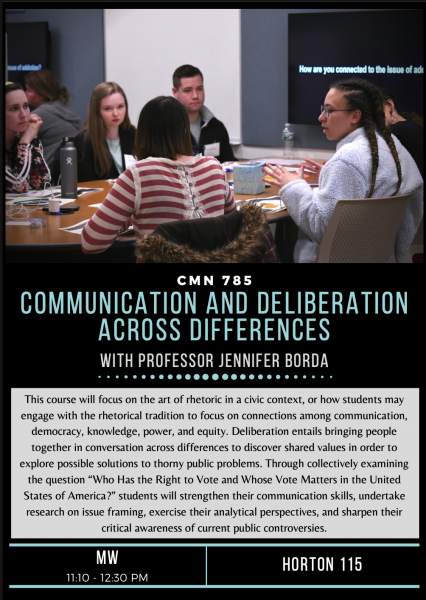
CMN 785: Communication and Deliberation Across Differences
INSTRUCTOR: JENNIFER BORDA
Deliberation entails bringing people together in conversation across difference to discover shared values, and to identify key tensions, in order to explore possible solutions to thorny public problems. The process of deliberative inquiry requires listening, exploring unbiased facts, analyzing adversarial perspectives, weighing options, negotiating tradeoffs, and finding where various interests overlap and can be joined to a shared future. This course will focus on the art of rhetoric in a civic context, or how students may engage with the rhetorical tradition to focus on connections among communication, democracy, knowledge, power, and equity. The question for this course is how might we turn individual interest into collective action? Through collectively examining the question “Who Has the Right to Vote and Whose Vote Matters in the United States of America?” students will strengthen their communication skills, undertake research on issue framing, exercise their analytical perspectives, and sharpen their critical awareness of current public controversies.
Course Syllabus
CMN 696: Seminar in Media Studies- Cultural Policy and Citizenship
INSTRUCTOR: JOSEPH TERRY
Despite accounting for 1/10,000th of the federal budget, a much-discussed point of contention during the 2012 and 2016 Presidential Elections involved federal support for public television, radio, and the National Endowment of the Arts in the United States. This course addresses the rationale and impact of policy interventions and subventions within the media, cultural, and arts industries. Even though we are surrounded by policy interventions and organizations aimed at providing support to arts and culture on a local, regional, national, and international level, there is often little understanding of how these institutions operate.
CMN 635: Contemplative Media Studies
INSTRUCTOR: KEVIN HEALEY
Contemplative Media Studies involves the application of contemplative practices and principles to the critical analysis of media content, technology, and institutions. It links Media Studies to Contemplative Studies, which integrates empirical social-science research (neuroscience, psychology) to first-person practices like meditation, yoga, and art therapy. Through academic essays and arts-based assignments, students strive to become more mindful digital citizens-creative yet critical, hopeful yet judicious with regard to the current and future course of technical development. Prereq: CMN 455, CMN 456, CMN 457; two 500-level CMN courses, or by permission.
CMN 540: Special Topics in Communication, Introduction to Civil Discourse
INSTRUCTOR: LYDIA REINIG
From our classrooms to our social media feeds, and our living rooms to our legislature, the vibrancy of our democracy hinges on how we talk about politics together. And yet, more often than not, these conversations are fraught with challenges and complications that can have adverse consequences for civic life. Introduction to Civil Discourse steps into the agora of civic discussion to consider: How do we talk about politics together in ways that foster the types of meaningful engagement we seek? To begin to answer this question, we survey the contemporary landscape of US American political discourse in practice, with a distinct orientation to: (a) the challenges of civility and incivility to cultivating civic discourse; (b) the prospects of deliberation for democratic action in diverse contexts; and (c) possibilities for constructive intergroup dialogue and disagreement around contentious issues. Albeit a first foray into a fraught topic, this course offers students an introduction to the promises and pitfalls of engaging in civil (or civic) discourse in their communities.
Course Syllabus

CMN 562 Collaborative Leadership
INSTRUCTOR: PROFESSOR RENEE HEATH
This course grounds the study of interaction in groups via theories of inter-organizational collaboration. Students will leave this course with a very specific set of knowledge and skills related to dialogue, principled negotiation, constructive conflict, consensus decision making and appreciative inquiry. Lessons focus on the development of a responsible ethic regarding how to share power among diverse group members. This ethic prepares you to lead collaborative groups in organizations, communities, and as family members.
Course Syllabus
CMN 662 Public Dialogue & Deliberation
INSTRUCTOR: PROFESSOR RENEE HEATH
This course explores the theory behind the practice of public dialogue and deliberation. It considers the distinctions and appropriateness of different types and aims of public participation, and how to best facilitate conversations important in the public sphere. The course anchors civil discourse as vital to democracy. Students will design, organize, and implement a public dialogue on campus, facilitating discussions on a relevant topic serving our community. Students marry practice with deep consideration of issues of equity, diversity, voice, representation, neutrality, and power.
Course Syllabus