Christopher P Ziadeh, Shayleigh B Ziadeh, Breanne H Aflague, Mark A Townley, Matthew P Ayres, Alexandra R Contosta, Jeff R Garnas. Distinct communities under the snow: describing characteristics of subnivium arthropod communities, Environmental Entomology, 2024; nvae017, https://doi.org/10.1093/ee/nvae017
Written by Chris Ziadeh ’23G, former Garnas lab technician and master’s student
Prior to starting this research, I knew nothing about winter arthropods or the “subnivium”. Once I started to dig into existing literature, I realized that it was a bit of a niche topic, with only a few dozen or so papers focusing on subnivium arthropods. Of the few studies there were, almost all of them focused on one thing, reporting the species that were collected from beneath the snow. I wanted to go a bit further and better characterize the subnivium community by calculating characteristics like richness, diversity, composition, and biomass. I also wanted to collect arthropods in the summer so I could compare summer communities with subnivium communities to figure out what subset of arthropods from the summer stay active in the subnivium during the winter.
We conducted this study in the Second College Grant (SCG), a township in Coös County NH that’s owned by Dartmouth College. We wanted an area that still had deep and persistent snowpack and due to its northerly latitude, the SCG was an ideal location. The Adaptive silviculture for Climate Change project has four experimental sites in the SCG with four different silvicultural treatments set up in each. We had 126 traps across all blocks and treatments but for this study we only focused on the arthropods collected from the control (unaltered forest) treatment which included 30 traps.
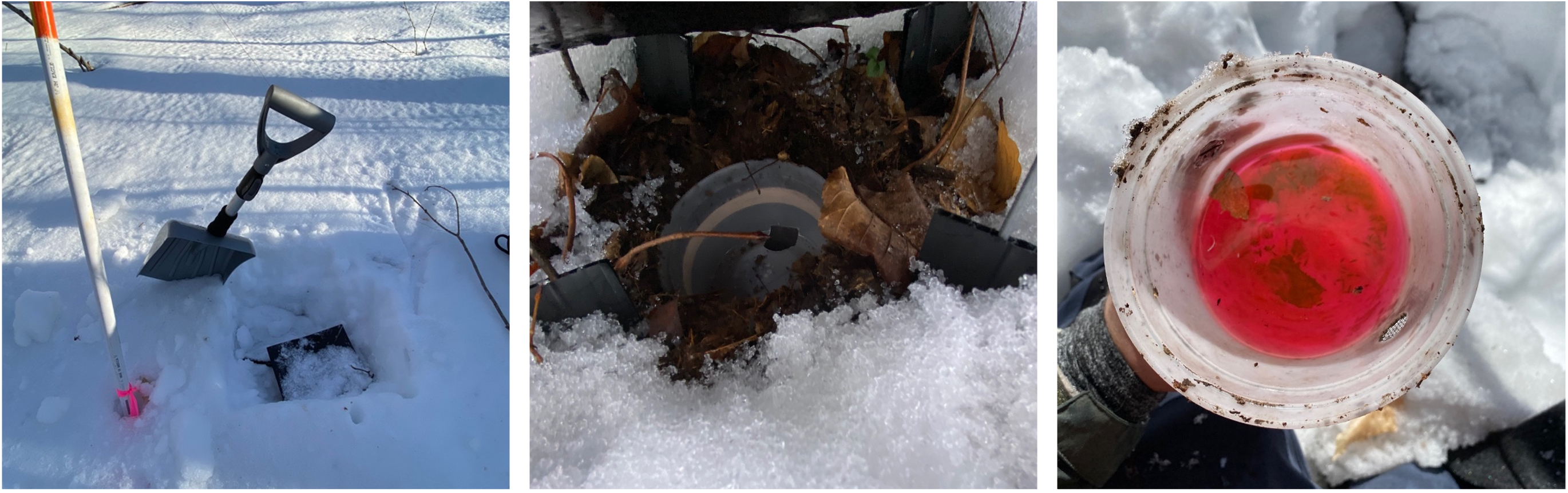
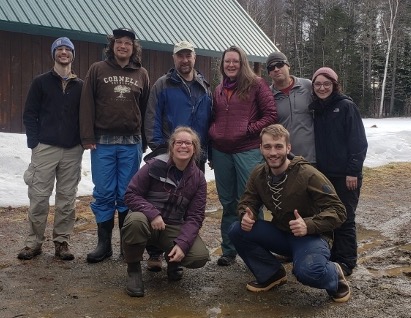
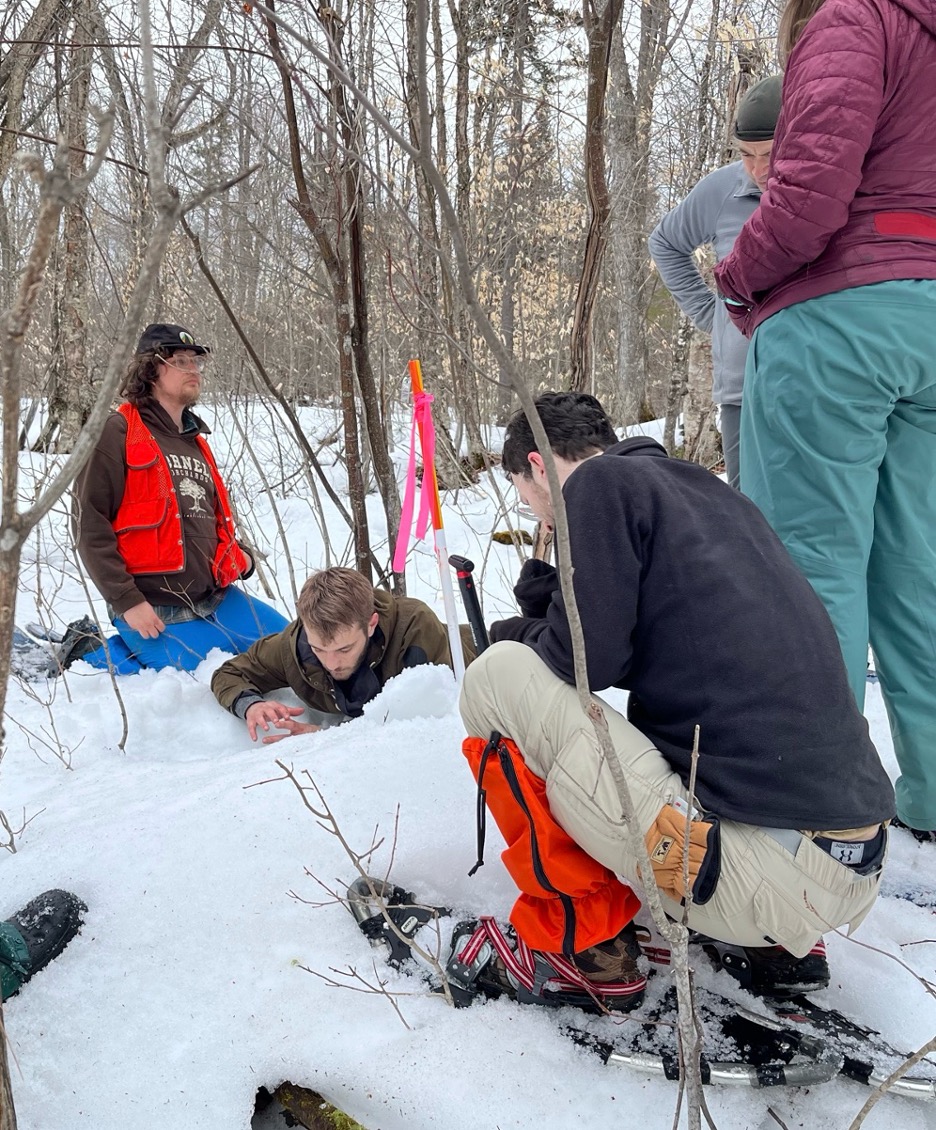
The fieldwork for this study was not easy as we soon discovered on our first trip to set up the pitfall traps. Across all the sites it required about 12 miles of hiking on steep inclines and often in dense undergrowth while carrying a load of equipment. This fieldwork became even more arduous when hip-high snow cover and below-freezing temperatures were present during the winter trips. It was both impractical and unsafe for me to try to do this fieldwork alone but technician help was sometimes in short supply. So, I relied on colleagues, friends, and family to help out. For most of the trips though it was just me and one other person out in the field, my wife Shayleigh (who is a co-author on this paper). She was by my side during every trip we took to the SCG, and even helped me develop the trap design and much of the methodology behind collecting the samples during the winter, without her help none of this research would have been possible! During one of the trips in the second winter the whole forest health lab came together to help dig up arthropods from the snow and they returned when we needed to pull all the equipment from the field site at the end of the study.

When it came to processing the samples, I went through them in the order in which I collected them, starting with the first winter samples, then summer samples, and then back to winter samples from the second winter collection. When I made the transition from winter samples to summer samples, I expected many things to be different, but I was still surprised by just how different the samples seemed to be between the seasons. One thing that really stood out to me was that I was no longer seeing many of the arthropods that were so abundant in the winter samples. This was shocking because I had started the research with the assumption that the winter community would simply be subset of what is present in the summer, rather they communities were seemingly completely different. Additionally, I reached the conclusion that the arthropods that were so abundant in the winter and absent in the summer were likely highly specialized for the subnivium environment, and that they were likely absent in the summer because they enter a state of summer dormancy (aestivation). I later referred to these arthropods as “subnivium specialists.” It was rather exciting to get a result that I had not even considered at the outset! I’m excited to finally have this work out there in its entirety and I’m hopeful other researchers will find some use in it.
With a project of this size I have many people to thank for helping out. Of course, all the co-authors contributed significantly and really helped elevate both this research project and the publication itself. Bre Aflague acted in many ways as a mentor, helping to navigate the challenges of ecological research. Bre also helped gather materials, develop methodology, helped out with fieldwork, and is an all-around great friend to have. Mark Townley was instrumental when it came to the spider aspect of this paper, he identified a good number of the spiders and taught me how to identify them. Mark also had a keen eye when it came to editing. Matt Ayres was involved from the start, contributing to the foundation of this research idea and added both his advice and words of encouragement. Alix Contosta’s knowledge of climate variables and snowpack was significant providing this paper with the snowpack knowledge background needed. Jeff Garnas of course was my advisor and helped develop many of the ideas behind the project and provided guidance. Beyond my co-authors, I would also like to thank the technicians who helped both in the lab and field, including Charlie Farrell, Deanna Flood, Casey Coupe, Jessica Grondine, and Al Searing. Additionally, several graduate students and postdocs volunteered their time to help collect samples, including Caroline Kanaskie, Kenneth Windstein, and Todd Johnson. Others outside of the ecological research realm volunteered their time to help collect samples, including Mark Medeiros, my brother Tim Ziadeh, Brian Taylor, Alexa Kip Smith, and Whitney (the dog!). Of course, this study would not have been possible without Dartmouth College and the Adaptive Silviculture for Climate Change project letting us use the SCG property and the larger ASCC project design to conduct this study. I would like to especially thank the Director of Woodlands Operations for Dartmouth, Kevin Evans, who saved the day on many occasions and without whom we would not have come back from our fieldwork in one piece! This study was a life-changing experience and so many different people came together to make it possible.
Additional Content:
Link to the publication: https://doi.org/10.1093/ee/nvae017 (email christopher.p.ziadeh@gmail.com to request a copy of the paper!)
Data resulting from this research: Ziadeh, C.P., S.B. Ziadeh, B.H. Aflague, M.A. Townley, M.P. Ayres, and J.R. Garnas. 2023. Arthropod communities in the Second College Grant, NH ver 1. Environmental Data Initiative. https://doi.org/10.6073/pasta/7333f727fc8396555d18913d6e8e6d52
Master’s thesis: Ziadeh, Christopher, “CHARACTERIZATION OF ARTHROPOD COMMUNITIES AND THE ENVIRONMENTAL VARIABLES THAT INFLUENCE THEM” (2023). Master’s Theses and Capstones. 1734. https://scholars.unh.edu/thesis/1734
Listen to Chris on NPR’s Science Friday! https://www.sciencefriday.com/segments/insect-ecosystem-between-snow-and-soil/
Read about this research in Entomology Today: https://entomologytoday.org/2024/05/08/subnivium-arthropods-winter-snowpack-climate-change/
Video on some of the winter field work: https://www.youtube.com/watch?v=o4RgTjLpMbY&t=10s