by Elizabeth Burakowski
December 13, 2024
Every December, the American Geophysical Union (AGU) holds its annual meeting bringing together over 25,000 scientists from over 100 countries. The Northeast Snow Survey Feasibility Study (NESS) team presented several presentations throughout the week of December 9-13th in Washington, D.C.
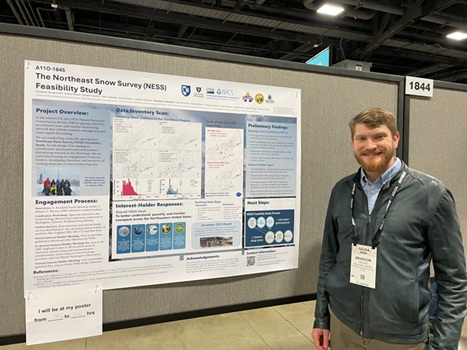
Braedon Lineman from the Appalachian Mountain Club (AMC) research office presented the team’s poster on Monday morning in the Ground-Based Atmospheric Monitoring Networks session. Braedon’s poster included key outcomes from our interest holder engagement activities, results of the data scan inventorying existing snow measurements across elevational gradients, and the next steps in our systems engineering plans.
At the session, Braedon spoke with dozens of fellow scientists interested in the expansion of snow monitoring in the northeast. “Presenting the NESS poster, I received cheerful enthusiasm from attendees for the project and lots of interest in seeing this network implemented. I spoke with Dr. James Thornton of the Mountain Research Initiative in Switzerland, who is part of a mountain observing group based in Europe. It was great to discuss the overlap in our challenges, goals, and design strategies.”
University of Vermont graduate student and NESS team member Anna Grunes gave an oral presentation on Monday afternoon on her work with SnowModel, a physics-based snow model she used to understand spatial and temporal patterns in snowpack variability across elevational gradients in Vermont. Anna’s talk featured SnowModel model calibration and validation using ground-based snow observations, including new data collected in the UVM Summit to Shore project currently funded through the Cold Regions Research and Engineering Laboratory (CRREL). Humidity and representation of liquid water in snowpack emerged as important factors to accurately simulate rain-snow partitioning and snowmelt runoff during heavy melt events, like the December 19, 2023 rain-on-snow event that caused dangerous flooding across the northeast, including communities in Vermont, New Hampshire, and Maine. Once SnowModel was calibrated to more accurately simulate snowmelt dynamics in the Northeastern US, it was used to conduct climate scenario analyses to assess potential impacts on snowmelt dynamics across elevations with changing temperature and precipitation patterns.
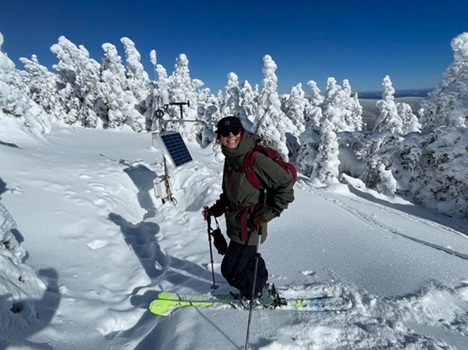
Anna said of her experience presenting at AGU, “The northeast is the perfect storm of unique characteristics such as its humid winter climate, complex shallow snowpack, low elevation terrain, forested landscape, and susceptibility to rain-on-snow that make it less well studied than other cold regions around the world, less accurately modeled, and much higher risk with projected warming. This intersection makes snow in the Northeastern US especially important to study as we see these changes occurring more rapidly in this region. It’s so exciting to see more presentations featuring the northeast at conferences like AGU to address this gap in research!”