by: Maddie Smith
August 12, 2026
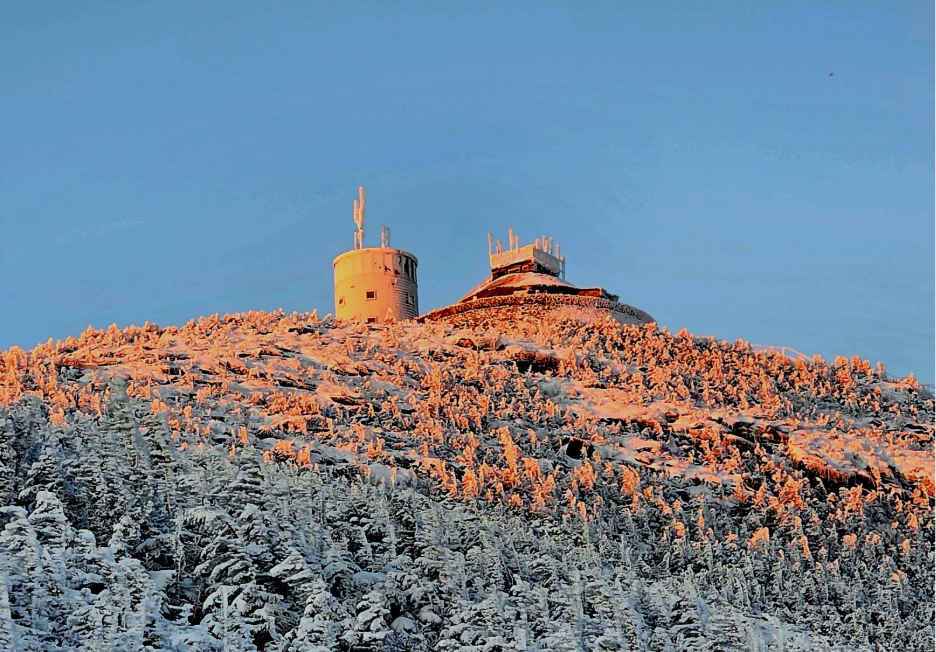
At Whiteface Mountain Field Station, the newest instrument in the Northeast Snow Survey Feasibility Study toolkit is now on the ground— a snow pillow! With funding from the Lintilhac Foundation, the first of two high-elevation snow pillows was installed to test instrument performance in the Northeast, with a second unit planned for Mount Mansfield across the Lake Champlain Basin.
A snow pillow is a deceptively simple idea: a large fluid filled bladder lies on the ground, and as snow accumulates on top of it, the weight of that snow is transmitted as pressure through the fluid inside, telling you how much water the snowpack contains. Snow pillows have anchored snowpack monitoring in the West since the 1960’s, and one is now installed at Whiteface to see how it performs in New York’s ice, wind, rain-on-snow events and freeze-thaw cycles.
History of Snow Pillows
Engineers with the U.S. Soil Conservation Service (now the Natural Resources Conservation Service) developed the first version of the snow pillow in the early 1960s and tested it at Reynolds Mountain East in Idaho, Lick Creek in Montana, and Mount Hood in Oregon. Findings from the Mount Hood study were published in 1965. The pillow became central to the Snow Telemetry, or SNOTEL, network that the agency began building across the western United States in the late 1970s, and it remains the standard method for measuring snow water equivalent (SWE) at automated stations today.
How Many Snow Pillows are out there?
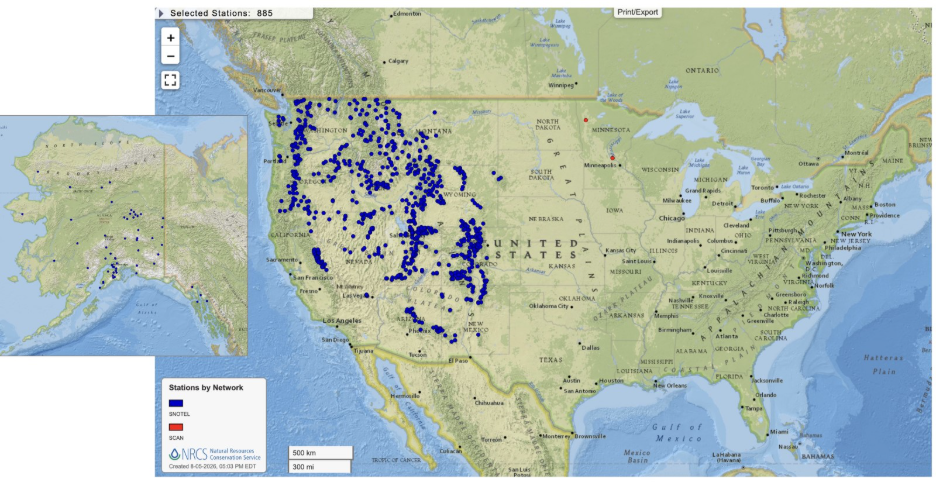
There are more than 900 snow pillows across eleven western US states and Alaska (Figure 1), operated within the SNOTEL network by the Natural Resources Conservation Service. Most of the snow pillows are installed alongside a precipitation gauge, temperature sensor, and snow depth sensor. In the Northeast, measurements of SWE have historically relied on manual methods that involve a person inserting a tube into the snowpack to collect a sampler, rather than automated sensors. The snow pillow at Whiteface is installed alongside snow scales, gamma ray sensors and ultra-wide band radar (see our previous post on Measuring Snow). The lack of automated SWE measurements is one of the primary motivations for the Northeast Snow Survey Feasibility Study.
What’s in a snow pillow?
The bladder of the snow pillow is made of Hypalon (similar to the material used for whitewater rafts) and filled with a mixture of water and SNOTEL Low Toxicity Antifreeze Mix. The bladder is installed on a level surface of sand and/or dirt and sandwiched with hardware cloth to keep large critters like moose and bear from puncturing the bladder.
How are they built?
Site selection comes first: Scott McKim, the science manager at the Whiteface Mountain Field Station, scouted a spot near the station’s other SWE and weather instrumentation with just enough slope to shed meltwater without pooling or skewing pressure readings. He cleared the vegetation and covered the ground with a tarp to kill off weeds.
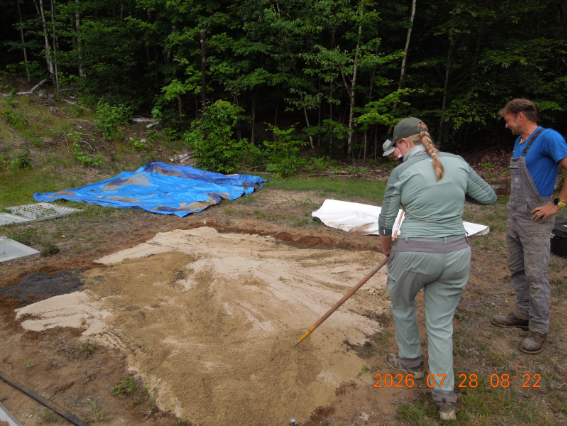
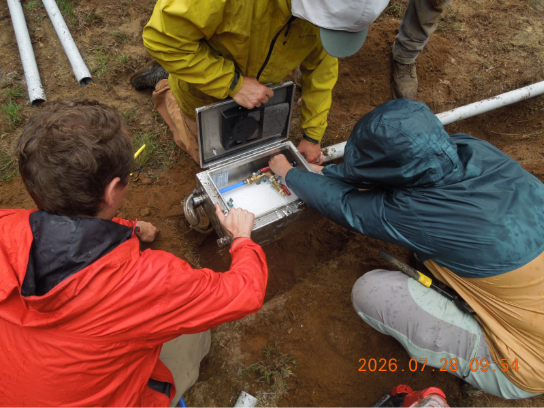
Next, we began the install process under the expert guidance of Lucas Zukiewicz from the Natural Resources Conservation Services. We pulled back the tarp, then leveled the site using bags of sand, pouring and spreading them until the ground was flat enough for the pillow (Figure 2). After confirming the pillow’s fit against the bed, we laid down hardware cloth, added a layer of felt padding, and placed the empty snow pillow bladder on top. We folded back its edge to expose the gasket fitting, trimmed away the hardware cloth beneath it, and dug a trench so the pillow could lie flush rather than press against the gasket. At the other end of that trench, we dug a hole for the pressure transducer box (Figure 3) and leveled it. A second layer of hardware cloth went over the pillow, with a larger opening and felt padding around the upper nozzle (or bung), and the top layer was sewn shut with mousing wire (Figure 4).
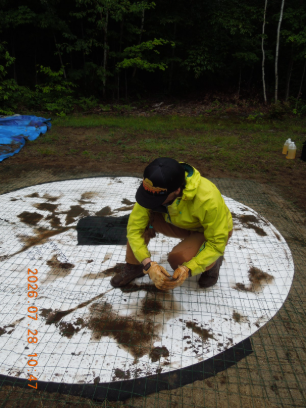
Next came filling the pillow with roughly 150 gallons of fluid, 75 gallons of water and 75 gallons of Propylene Glycol/Ethanol and Polysorbate (SNOTEL Low Toxicity Antifreeze Mix), while other team members finished sewing the hardware cloth together and trimming it into a circle matching the pillow’s shape. Once full, the crew jumped on and around the pillow to work out trapped air bubbles, then buried the edges with dirt and sand to finish the installation. As a final check, team members sighted from the pillow’s surface downhill to a ground-truth stake to confirm the elevation difference was accounted for and leaving it ready for electronics on day two (Figure 5).
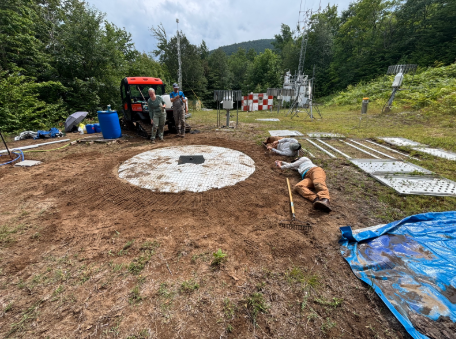
Watch the install here:
One of Many Instruments
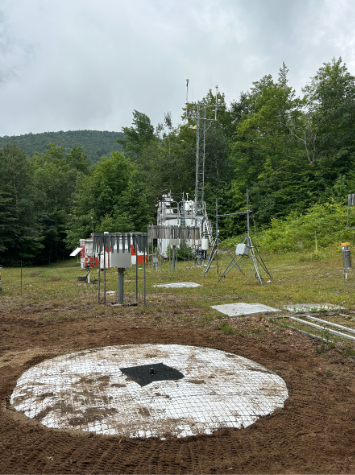
The new snow pillow doesn’t stand alone. It joins a growing collection of SWE measurement technologies at the Whiteface Mountain field station site (Figure 6). This collection of different technologies will allow the team compare how each instrument performs:
- Snow pillow (a la SNOTEL, pieces & parts from various manufacturers)
- Gamma (Campbell Scientific 725)
- Sommer SnowScale SSG-2 EN
- 2KR SnowScale (600 model)
- GNSS (dual-antenna differential GNSS, ANavS S-ROX)
- Cosmic‑ray muon‑based sensing (HydroInnova Bruno)
- Manual cores: Mix of NYSM / Whiteface Mountain Field Station
What We Hope to Learn
Running a snow pillow alongside gamma, GNSS, and cosmic ray sensors at the same site gives the Northeast Snow Survey Feasibility Study a side-by-side comparison. That comparison is a crucial step toward answering the central question behind the project: what instrumentation does the East need to reliably measure its snowpack now, and as the climate continues to change?
Acknowledgements
Thank you to Scott McKim and the Atmospheric Sciences Research Center for scouting and preparing the site, the field crew who spent the day installing the pillow, New York State mezzanine and Whiteface Mountain field station for hosting and supporting this instrumentation, and Lucas Zukiewicz and the Natural Resources Conservation Services whose years of SNOTEL experienced informed this design and installation.
The Northeast Snow Survey Feasibility Study is supported by federally appropriated funding through the USDA Natural Resources Conservation Service. The purchase of the snow pillow was funded by the Lintilhac Foundation through a gift provided to the University of Vermont Water Resources Institute.