
Smart Insole
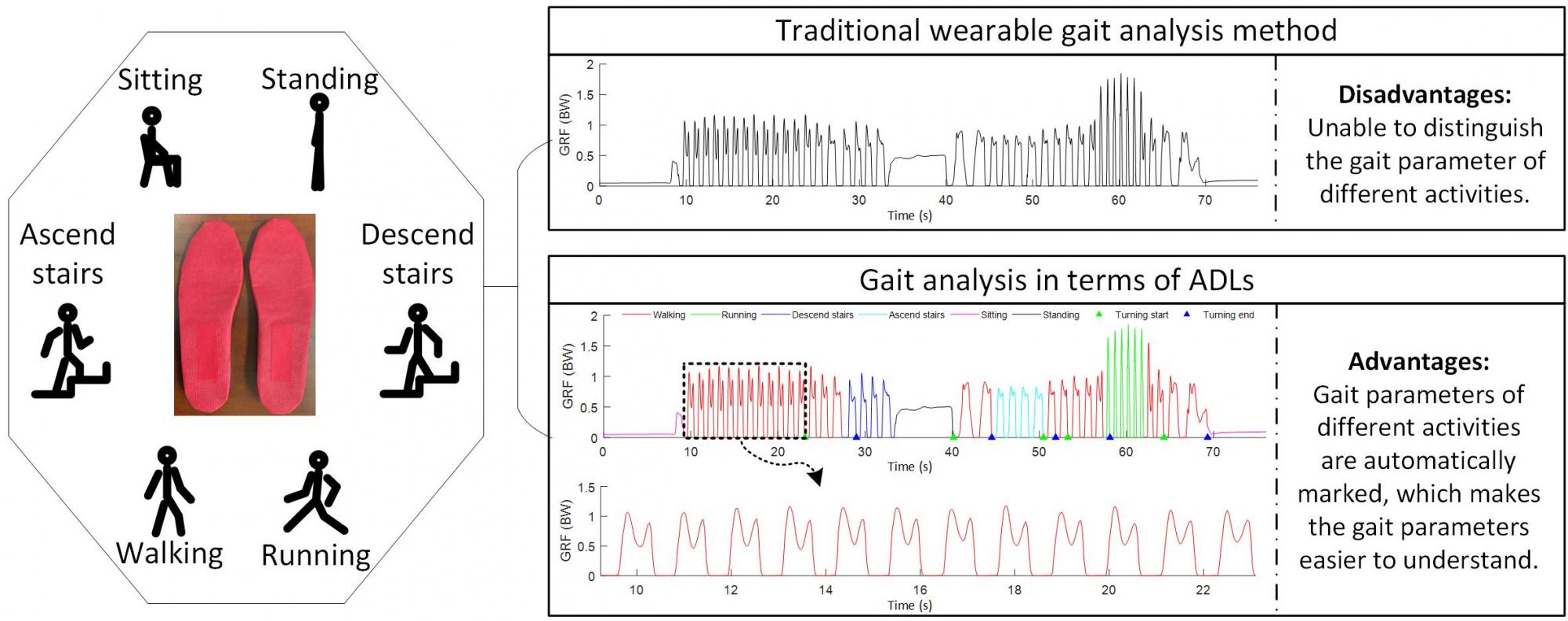
 Gait analysis is a systematic study of human motion. For individuals with diseases that affect the locomotor ability, gait analysis is helpful in making detailed diagnoses, plan optimal treatment, and evaluate rehabilitation outcomes. Although wearable solutions have been proposed to show the capability of measuring gait parameters in free-living environments, one research gap is that since both diseases and activities could influence the pattern of gait parameters, without knowing the corresponding activities, the measured gait parameters cannot be used in clinical applications.
Since the signals measured by Smart Insole could be used for both gait analysis and activity recognition, to fill the research gap of existing gait analysis methods, we proposed a novel gait analysis method – “gait analysis in terms of activities of daily living (ADLs)” by introducing new activity recognition technologies to assist in gait analysis. There are two challenges for the activity recognition technology: (1) to make the measured gait parameters be indicated with a correct activity, different activities have to be clearly separated and accurately recognized; (2) to enable a wearable solution, the activity recognition algorithm should have a low computation load and be able to run on a mobile device. To address these two challenges, we introduced characteristics of human gait to assist in activity recognition . For data segmentation, instead of using the traditional sliding-window based method, which is inefficient and cannot clearly separate different activities, we proposed using “stride” as the unit for data segmentation, which based on the fact that one stride only includes one activity. The “stride” based data segmentation method simplified the activity recognition problem of a time period to the activity recognition problem of each stride in the time period. To decrease the computation load, only three effective features were extracted based on human gait characteristics to train a linear Support Vector Machine (SVM) model for activity recognition, and achieved a high accuracy (>99%), which outperforms the existing methods with tens of general features.
Finally, different colors were used to highlight the gait parameters acquired during different activities. “Gait analysis in terms of ADLs” makes it easy for clinicians to see whether the changes of gait parameters were caused by activities or diseases.
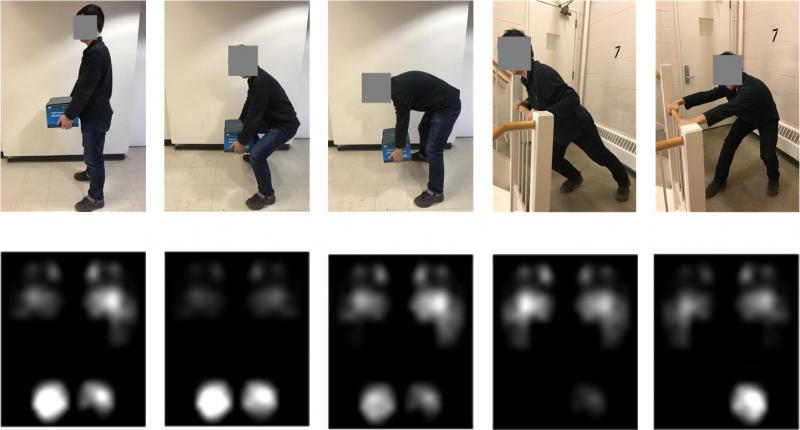 Work-related musculoskeletal disorders (WMSDs) are leading nonfatal occupational injuries. Risk factors of WMSDs include overexertion, working postures (e.g. lifting, carrying, pushing, pulling, and bending), and repetitions. Wearable solutions for risk factors recognition have the potential to avoid WMSDs. However, most existing solutions only focus on the recognition of working postures with IMU sensors, which cannot systematically evaluate the risk of WMSDs. To address this problem, I proposed using the plantar pressure signal measured by Smart Insole for systematical risk factors identification. This proposition is based on the fact that all these five working postures need the support of both feet. Force exertions would lead to an increase in the pressure amplitude; Different working postures have different pressure distribution patterns; Sequential motions have cycling influences on the pressure patterns. Therefore, all these three risk factors of WMSDs could be recognized from the measured plantar pressure with AI algorithms, such as sequential minimal optimization (SMO) and long short-term memory (LSTM) networks.
Publication: [1] Chen D, Chen J, Jiang H, et al. Risk factors identification for work-related musculoskeletal disorders with wearable and connected gait analytics system[C]//2017 IEEE/ACM International Conference on Connected Health: Applications, Systems and Engineering Technologies (CHASE). IEEE, 2017: 330-339.
[2] Chen D, Cai Y, Cui J, et al. Risk factors identification and visualization for work-related musculoskeletal disorders with wearable and connected gait analytics system and kinect skeleton models[J]. Smart Health, 2018, 7: 60-77.
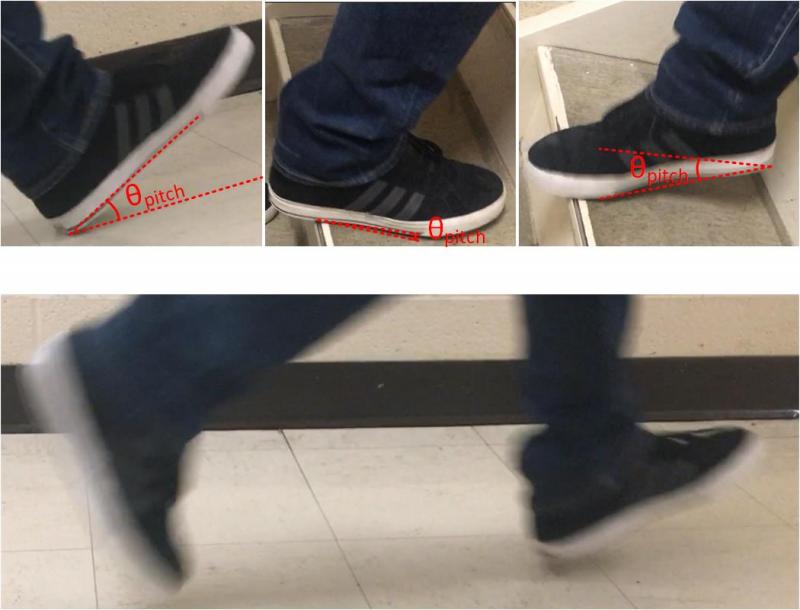
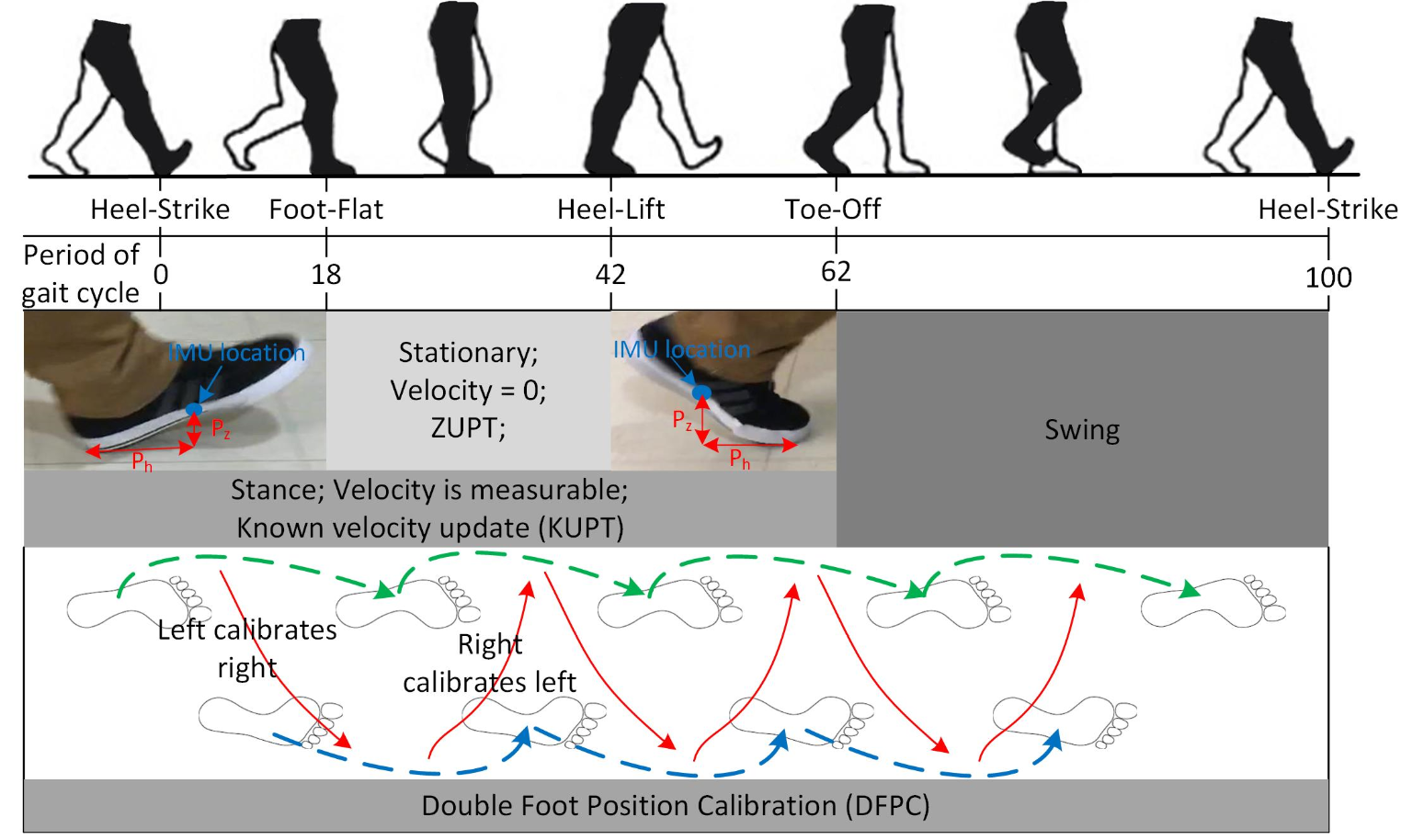 Indoor localization is important for a diverse range of IoT applications, such as healthcare and worker safety. IMU-based localization system is a research focus, but it suffers from the drift problem caused by the measured acceleration signal. To alleviate the drift problem, we introduced characteristics of human gait to assist in indoor localization applications. Firstly, Human gait characteristics were introduced to decrease the time period when the velocity has to be calculated with acceleration. A human gait cycle consists of a stance phase and a swing phase. During the stance phase, the velocity of the IMU sensors could be calculated through the measured shoe dimension and foot angle. Therefore, the velocity of 62% of a gait cycle time can be measured without using the acceleration signal. To increase the localization reliability, the second part of the method makes use of the symmetry characteristics of human gait to fuse the stride length of both feet. Experiment results showed that the proposed method could significantly improve the localization accuracy.
Smart Prosthesis
Coming soon...
Smart Glove
Coming soon...
Physiological Paramenters Measurement System
Coming soon...